

Patient Testimonial

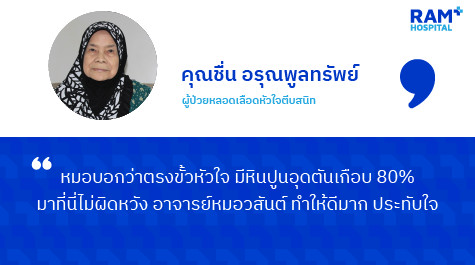
"I felt no pain, just a sensation like something moving inside me. After leaving the catheterization lab, my chest felt clear, with no wound pain—just a little drowsiness."
In the early hours of Monday, June 17, the medical team at Ramkhamhaeng Hospital's Cardiac Catheterization Center performed a cardiac catheterization on Police Sub-Lieutenant Vararon Ruechaikiat, 44. After this significant procedure, he recounted the origin of his heart condition. Earlier this year, he experienced chest pain, and a preliminary examination revealed severe blockages in three coronary arteries due to fat deposits. One artery was completely blocked, allowing no blood flow, while the other two were dangerously obstructed.
The treating physician recommended urgent intervention at Ramkhamhaeng Hospital's Cardiac Catheterization Center, which is fully equipped to treat such conditions without bypass surgery. This news brought him great relief, as he and his family were deeply concerned about the prospect of surgery.
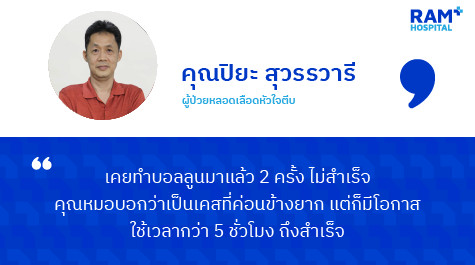
“It's a difficult case. Because it has been done twice and failed, but there is a chance."
I have had a blood lipid test since I was about 35 years old. It turned out that my arterial lipid values were high. But we think that we exercise, and diet should help, and I think that we are young. And we still did not want to take drugs and lived like that until we were around 50. Until the end of last year, I felt that the fat was high for a long time and became uncomfortable, so we went to the hospital to check for a CT scan. We can find out what methods can be examined. It appears that the CT scan is too high. The risk factor is around 400. But mine is 1,100. This means that the coronary artery is likely to have a problem. But we still do not do anything and still live a normal life. I had the opportunity to go to a senior basketball tournament in Chiang Mai. My teammates later told me that there was a Heart Attack symptom. During my rest, I had a faint heartbeat, and I finally stopped breathing. But fortunately, in the gym, there was an athlete cardiologist on the court, so he tried to do it. CPR until rescuers brought the machine AED, shocked my heart, and immediately rushed me to the hospital in Chiang Mai. It turned out that night, there were two balloon surgeries. The left strand was narrowed by 80% but succeeded. The right strand was narrowed 99% that night did not succeed. But at least it is a certain level of safety.
When I return to Bangkok. I was still worried that the right strand was still constricted. So I went to another hospital for balloon surgery, and it was still unsuccessful. Until I got to know Dr. Wasan's name. I also looked at the history of treatment, how to treat this kind of treatment. After that, I came to find out about what hospital he worked at. When I came and talked to him, He suggested that it was a difficult case because it was done twice and failed, but there was a chance, so how much of a chance did we have to try a Coronary Angiography to get the answer? Because if done, it is likely to be cured. The doctor will do the treatment. I began to prepare myself for the body to enter the room at about 9 pm. Once the injection was complete, the doctor looked at it and it was highly possible to do that night, then we did it. In normal cases, it may take a short time because balloon surgery may take less time.
But after it was done, Dr. Uthai, who also attended the case, said it was quite a difficult case over the years. That night took about 5 hours to complete. The right heart vein returned to normal. So now I have all three coronary arteries as usual. The condition of my body is good, walking normally. And then I can begin to exercise a little.
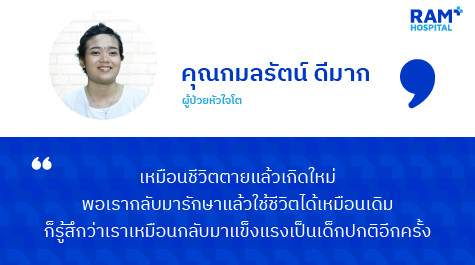
Former Cardiomegaly Patient: Kamonrat Deemark's New Lease on Life
"...It feels like being reborn. At that time, I felt like I was already dead. Now that I've received treatment and recovered, I feel strong again, like a normal child. That's because chemotherapy made my hair fall out and caused heart failure, to the point where I never thought I'd be as well as I am today... I want to thank all the doctors who treated me, from when I had an autoimmune disease, then leukemia in my lymph nodes, and finally heart failure. I truly want to thank them for giving me a new life."
Initially, Kamonrat Deemark suffered a bladder infection, leading to high fever and incessant vomiting. This progressed to a bloodstream infection, causing bruises on her arms and later lumps on her legs, making it difficult to walk. A biopsy revealed leukemia, requiring over six months of chemotherapy before her condition improved and she became cancer-free.
Unforeseen Heart Complications
Just three months later, new symptoms emerged: she couldn't lie flat due to breathing difficulties, and experienced vomiting and insomnia. Dr. Bandita assessed her, ordered an X-ray, and discovered an abnormally enlarged heart—it nearly filled the entire left side of her chest cavity, far exceeding the normal size (typically less than half the chest). Signs of pulmonary edema (fluid in the lungs) were also present. An echocardiogram further revealed that her heart muscle was severely weakened, functioning at only 29%, coupled with a leaky heart valve due to the enlarged heart structure. These factors caused her extreme fatigue upon hospital admission.
Recovery and Return to Normalcy
Following treatment involving medication adjustments and cardiac rehabilitation, a re-examination showed that her heart size had significantly reduced to near normal, with no signs of pulmonary edema. With medication to enhance heart contractility, her heart strengthened, allowing her to be discharged and resume her daily life and studies.
Beyond Recovery: Embracing Life Fully
After discharge, Kamonrat's mother consulted Dr. Bandita regarding her daughter's confidence in returning to physical activities she once enjoyed with healthy friends. Dr. Bandita recommended a VO2 Max test, a standard method for assessing cardiac performance in heart failure patients, using stationary cycling or treadmill running. The results confirmed Kamonrat's heart health was quite strong. The doctor then advised on further exercise. Kamonrat has since applied this information to her daily life and exercise routine. Currently, she can participate in sports and physical education just like her peers and has even successfully competed in singing contests, fulfilling her aspirations.