

Patient Testimonial

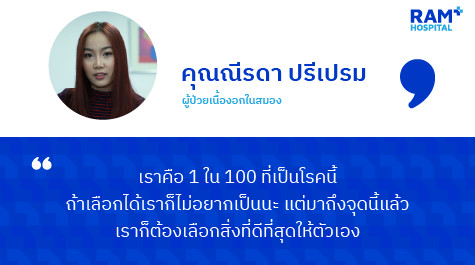
Former Brain Tumor Patient's Journey
"The word 'tumor' felt so distant, especially being so young. I thought, 'Do I have a tumor?'" said Ms. Neerada Preeprem, a 24-year-old former brain tumor patient. At her age, the odds of developing a tumor are only 1 in 100.
After experiencing frequent dizziness, visiting multiple hospitals, and finding no relief from medication, Ms. Preeprem developed sharp, intermittent headaches for 5-6 consecutive days, rendering her unable to sleep or work. She sought treatment at Ramkhamhaeng Hospital.
Initially, I received medication for a suspected migraine, as other tests showed no abnormalities, and it was attributed to my lifestyle. However, my condition didn't improve, so I returned to the doctor. This time, I was sent for an MRI, which revealed a tumor on my pituitary gland."
Learning this was a shock, and many thoughts flooded her mind. The doctor explained the treatment options: surgery or medication. Ms. Preeprem initially favored medication due to her fear of surgery, specifically the thought of brain penetration and the daunting image of an operating room with orange lights and blood-stained green drapes. However, medication meant lifelong treatment and only shrinking the tumor, not removing it. She requested time to decide and consult her family. The doctor respected her decision, understanding her fear.
Ultimately, she chose surgery. The doctor clarified that it wasn't the invasive procedure she imagined; it was endoscopic surgery through the nose, leaving only a small incision. Before the surgery, the doctor conducted thorough examinations, which, while extensive, reassured her of their meticulous care. The operating room environment was not as intimidating as she had pictured; the medical staff were smiling and attentive. After anesthesia, she woke up feeling no pain and was pleasantly surprised; her fear of surgery was gone. She recovered in just two nights and was discharged. Post-surgery care involved minor attention to the nasal incision, which healed completely in less than 15 days.
Many questioned her choice of hospital. She confidently stated, "This hospital has excellent equipment and skilled doctors, ensuring no waiting for treatment—some things can't wait, right? The service here is also exceptional; the doctors, nurses, and even the staff took great care of me. If I pay a little more and get such good results—a new life—I'm willing to pay."
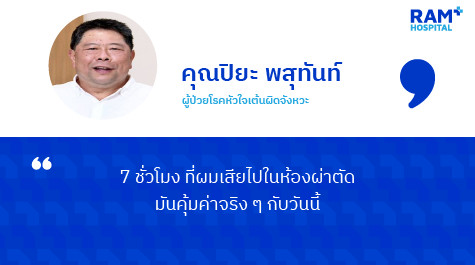
“After I had defibrillation implant surgery two years ago, I thought the severe symptoms from arrhythmia would be over. Able to travel abroad normally without worrying that symptoms will recur and possibly death at any time. But suddenly, an unexpected incident happened. When I have a heart disease that has arisen without knowing the cause !!
.
So I decided to come here. Upon examination, the heart was found to lack potassium. At first, the doctor prescribed potassium supplements. But it was never cured. Finally, the doctor recommends the treatment of electrolysis technology. Listening to it should help things get better. So I decided to do it."
Doctors have to tell you that this method is quite complex and can take a long time. The doctor doing the treatment must have great expertise, and the equipment must be ready. Because if an error occurs, the patient's heart can be damaged and die. For Mr. Piya, it takes up to 7 hours for the surgery by electrocautery. It can be treated in 2 large areas. And there are still 2 small points that cannot be operated on by electrocautery immediately. The doctor then considered the treatment for 2 points later.
After the surgery, Mr. Piya was able to live the same life. Because he follows the instructions strictly. With medication regularly. Reduce your stress from work. Get enough exercise and rest. Severe arrhythmias do not recur. Even if you have to travel abroad for 15 hours, symptoms will still be fine. We are glad to be a part of Piya's recovery from the symptoms. Make his life safer and more comfortable.
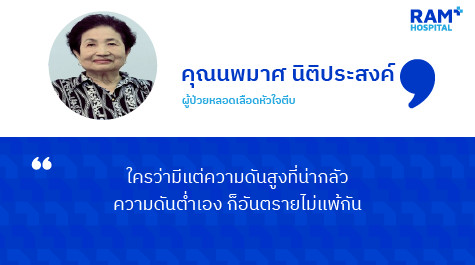
"I used to climb stairs many times a day, but suddenly I became easily exhausted and couldn't do it as often. I also had persistent neck and jaw pain, and a heavy head. This went on for 2-3 days. One day, while talking to a neighbor, I felt extremely tired and my face turned pale, so my grandchild rushed me to Ramkhamhaeng Hospital."
These were the initial symptoms of Noppamas Nitiprasong, who never expected low blood pressure to impact her life so severely.
Diagnosis and Urgent Treatment
After taking her medical history and checking her blood pressure, doctors found Ms. Noppamas had critically low blood pressure, putting her at risk of hypovolemic shock due to insufficient blood circulation. Further investigation revealed acute coronary artery stenosis, which severely affected her heart rhythm, causing a "severe abnormal slow heartbeat." Urgent treatment was required.
Once her dangerously low blood pressure was stabilized, doctors performed a coronary angioplasty and stent placement to restore blood flow to her heart.
Swift Recovery and Important Warning
Thanks to timely treatment, expert medical care, and well-equipped facilities, Ms. Noppamas recovered in just three days at the hospital. She then had regular follow-up appointments and has now returned to her normal daily life. Such severe symptoms, if mismanaged, could lead to serious health consequences or even loss of life. Therefore, whether you experience high or low blood pressure, it should never be ignored.
With best wishes from the Ram Doctors.