

Patient Testimonial

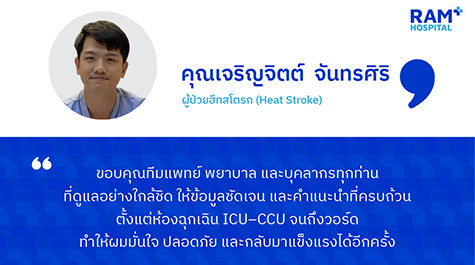
Heat Stroke Patient
Mr. Charoenjitt Chandrasiri – Interview
“I would like to thank all the doctors for their care, guidance, and for providing treatment options with clear and detailed information. I was fortunate to receive care from the Emergency Department team.”
“I remember finishing the race and feeling like I wanted to rest—then everything went blank.”
“When I regained consciousness, I received excellent care. After waking up, I had no chest pain, no chest discomfort, and no dizziness. The doctors conducted cardiac evaluations, including a coronary angiography to assess the condition of my blood vessels, and informed me that my coronary arteries were normal. The doctors and nurses also advised me on taking care of my health—how to assess my physical condition, consider weather conditions, and evaluate my readiness before engaging in various activities.”
“Once again, I would like to thank all the doctors for their attentive care, clear guidance, and comprehensive information. I received excellent care from the Emergency Department, the ICU and CCU teams, as well as the inpatient ward. Whenever I asked for assistance or advice, everyone provided clear answers, attentive care, and thorough explanations.”
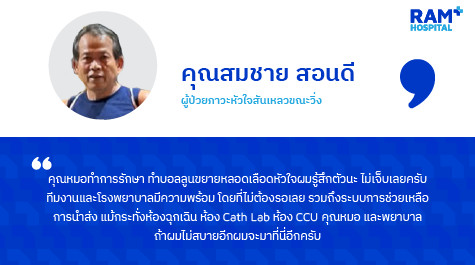
Former Patient's Account: Heart Failure During a Run
Somchai Sondee recounts his experience:
"I'm a regular runner but never had annual check-ups. Three years ago, I fainted once but could continue walking. I don't have any underlying conditions. This time, I was running my first half-marathon (21.1 km) after a three-year break due to COVID-19, with minimal training. Around the 8 km mark, on the second bridge, I felt exhausted, then blacked out. I regained consciousness in the ambulance after receiving CPR, hearing the doctor, also a runner, say, 'I'm so glad we could help him.' Tears just streamed down."
"I just thought someone ran into me. I couldn't open my eyes, my chest hurt, I was dizzy, and couldn't speak. I felt like it was 50/50 whether I'd make it. Upon arriving at the hospital, I was rushed to the emergency room, hooked up to oxygen and various machines. I was conscious and felt no pain when the doctor performed the balloon angioplasty to widen my coronary artery."
"Everything was excellent. The team and hospital were fully prepared, with no waiting. This included the rescue system, transport, emergency room, Cath Lab, CCU, doctors, and nurses. If I get sick again, I'll definitely come back here."
Cardiologist's Perspective: Dr. Somsak Ekprachakul
Dr. Somsak Ekprachakul, a cardiology specialist who treated Mr. Sondee, stated:
"When Mr. Somchai arrived at the hospital, he was conscious. We immediately began diagnostics. His EKG showed abnormalities consistent with acute myocardial infarction. We quickly performed a cardiac catheterization to assess his blood vessels. One of his three main heart arteries was severely narrowed, almost completely blocked. We used a catheter to insert a balloon and immediately expanded the artery. Then, a stent was deployed to keep the vessel open, all in one procedure."
"This patient's case was considered cardiac arrest. There was no blood flow from the heart to the brain, leading to unconsciousness within seconds. Resuscitation is critically important within the first five minutes after losing consciousness. If revived, it's crucial to open the coronary artery within four hours."

Patient with 3 Blocked Coronary Arteries and COVID-19 Infection
Mr. Jasmin Rangsakorn's son shares his experience:
"The treatment was easy to understand, clearly explained, visual, and very fast."
My father had been experiencing chest tightness for about two weeks, feeling like food wouldn't go down. He initially thought it was due to lack of sleep or acid reflux. Resting more didn't help, and the constant chest tightness led to sleepless nights. We later learned these were symptoms of fluid build-up in his lungs, making it impossible for him to lie flat. One night, his condition worsened significantly, and he couldn't breathe, so we rushed him to the hospital. He was diagnosed with three blocked coronary arteries and treated with angioplasty. Coincidentally, this was during the Omicron outbreak, and my father also contracted COVID-19. It was fortunate he could receive immediate treatment, as finding a hospital bed was difficult then.
The doctors provided excellent care with modern equipment and valuable advice on his treatment plan. The explanations were clear and easy to visualize, and the treatment was incredibly fast; my father was wheeled out in no time. Finally, I want to emphasize the importance of regular health check-ups. If you don't take care of yourself, you must get screened. Another crucial point is that heart disease can be dangerous because it develops gradually. It can easily be mistaken for acid reflux or other conditions. It's better to get checked early while you can still walk, rather than waiting until you need to be stretchered in, as it might be too late.