

Patient Testimonial

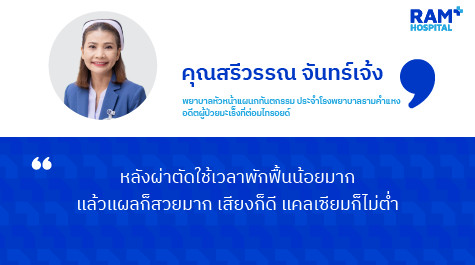
"I feel incredibly fortunate to be an employee of Ramkhamhaeng Hospital."
"After the surgery, my recovery time was surprisingly short. The incision is beautiful, my voice is good, and my calcium levels are stable. I truly feel my morale significantly improved, encountering a doctor who could treat me in time, despite my belief that my condition was severe. My sister, who had the same condition, needed about 4-5 months of recovery and two additional surgeries, not at Ramkhamhaeng Hospital. I was amazed that after my surgery, I could walk around normally at home, even asking the doctor if I could exercise. He advised against immediate strenuous activity but said housework was fine. I swept and mopped the house right after surgery."
"My recovery period was just one month; my incision and body are excellent. I don't even know how the doctor performed the surgery. Initially, I heard a thoracic surgeon might be needed to assist with an open chest procedure, which made me think of months of recovery. However, the doctor was incredibly skilled; the thoracic surgeon wasn't needed, and the surgery was successful. The doctor confirmed everything was removed, and my cancer test result was 0.1. He told me I was cured but, as a standard precaution, suggested a single radioactive iodine treatment, which I completed. I have follow-up scans every six months to check for recurrence, and my latest results show no cancer."
"I feel incredibly lucky to be a Ramkhamhaeng Hospital employee. If I worked elsewhere, I wouldn't have received such excellent care. The management is incredibly supportive, constantly checking on my well-being, offering assistance, and asking if I have any problems they can help with. I'm very impressed, including with Dr. Puripun, who was so caring and performed my surgery. Thank you very much, Ramkhamhaeng Hospital."
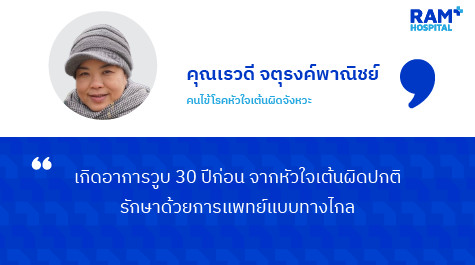
Patient with Arrhythmia
Experienced fainting 30 years ago due to abnormal heart rhythm; treated via telemedicine.
"...It happened when I was about 30. Initially, I just felt numbness at the base of my tongue and jaw. My heart would flutter, and I'd faint. I first went to Ramkhamhaeng Hospital, but they found nothing because I had no symptoms at the time, and the doctor thought it was just a regular faint. Then one day, I was riding on the back of a motorcycle in the village when I fainted and fell off. A neighbor saw it and took me to Ramkhamhaeng Hospital, where I met Dr. Wichai. He was suspicious because I was so young to have such symptoms. After a heart check-up, he had me wear a Holter monitor, which showed an abnormal heart rhythm. The doctor immediately called me back to the hospital for medication. After that, I improved and was told to take the medication daily. The doctor had initially said I might need to take medication for life to control my heart rate. After that, I fainted two or three more times, went back to the doctor, and received intravenous medication. I wondered what caused it, and the doctor explained that stress could be a factor. I thought that was probably it, as I had work problems and many other issues simultaneously. So, I decided to change my lifestyle, trying to eliminate all problems to avoid dwelling on them, and started exercising until I felt better. When I had no more fainting spells, I tried stopping the medication... I stopped for over 20 years and was fine, so I never saw a doctor again. I lived a normal life with no warning signs whatsoever. Then, suddenly, on February 28th, in the afternoon, I was walking in my room and just collapsed without any warning. Luckily, it was only for a moment. When I got up, I remembered my old symptoms. But after sitting all day, nothing else happened. Then, in the early evening, while leaning back watching TV, I felt faint and my heart pounded, and then I fainted repeatedly. I knew this was very unusual, much worse than before – I felt exhausted from the repeated fainting. So, I called an ambulance to take me to Ramkhamhaeng Hospital, knowing Dr. Wichai was still there, even after all these years. Although my medical records weren't there anymore, the doctor remembered me fainting and falling off the motorcycle. Dr. Wichai, along with Dr. Buncha, worked together to examine and treat me from that day on. They put a Holter monitor on me, but I didn't experience any symptoms..."
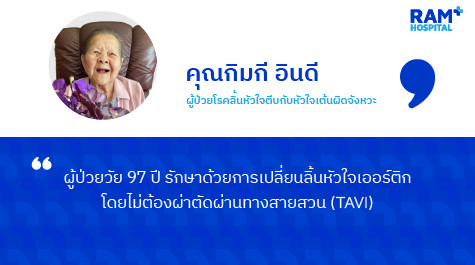
Aortic Valve Stenosis with Cardiac Arrhythmia
“A 97-year-old patient treated with Transcatheter Aortic Valve Implantation (TAVI), without open-heart surgery.”
“…During the period when COVID-19 began to spread more severely, ‘Khun Yai Kimki’ told her children and grandchildren to postpone doctor visits for the time being. However, after being away from medical care for about 7–8 months, she began to experience fainting episodes 3–4 times a week.
Her children and grandchildren, who were caring for her, took her to a nearby hospital as they felt it was an emergency and should not be delayed. Out of trust in Ramkhamhaeng Hospital, they contacted the hospital to seek treatment with Dr. Vichai Srimanus.
Upon arrival, she underwent a step-by-step diagnostic process, leading urgently to cardiac catheterization with contrast injection. This allowed the cause to be identified and continuous treatment to begin. It was determined that the underlying problems were aortic valve stenosis and cardiac arrhythmia.
Her daughter, Khun Phosri Indi