Due to the increasingly severe COVID-19 outbreak, thousands of people are infected daily, causing a shortage of hospital beds. Additionally, COVID-19 patients with mild symptoms may not require hospital care, or may stay in the hospital for a short period before recovering at home or in government-provided facilities.
If you need to undergo Home Isolation, here is what you need to do.
Check Your COVID-19 Symptoms: Which Level Are You At?
The Department of Medical Services, Ministry of Public Health, has classified COVID-19 patient severity levels into Green, Yellow, and Red for systematic medical management. They are divided into 3 groups as follows:
Therefore, home isolation guidelines for COVID patients must be under a doctor's consideration and within a system that monitors and tracks symptoms. If symptoms change, there is a referral system to transfer the patient to a hospital.
Home Isolation (Home Isolation) Should Follow These Criteria:
- Patients Awaiting Admission: or waiting for hospital treatment, and a physician determines that they can recover at home.
- Patients treated in a hospital or government facility for at least 10 days: and a physician deems they can continue Home Isolation at home.
Criteria for Individuals Eligible for Home Isolation
- Infected individuals who feel fine or are asymptomatic cases
- Under 60 years old
- Good overall physical health
- Consent to isolate in their own accommodation
- Living alone or with no more than 1 co-resident
- Must not be obese (Body Mass Index >30 kg/m² or weight >90 kg)
- No co-morbidities such as:
- Chronic Obstructive Pulmonary Disease (COPD)
- Chronic Kidney Disease (CKD Stage 3,4)
- Cardiovascular Disease
- Cerebrovascular Disease (Stroke)
- Uncontrolled diabetes or other medical conditions at the doctor's discretion
Suitable Environment for Home Isolation
If the house has sufficient space, the patient can be isolated in a private room alone.
- If possible, use a room with an en-suite bathroom: and use separate personal utensils and belongings.
- For meals, place food in front of the room and notify via LINE: so the patient can open the door to pick up their food, avoiding verbal communication or direct contact as much as possible.
- Meal boxes are preferred: because washing dishes may increase the risk of exposure to the virus.
- If living in a condo, apartment, or flat: and there is not enough space to isolate clearly, for safety reasons, it is recommended that the patient stay in the room alone, while uninfected household members temporarily stay elsewhere to reduce infection risks for family members.
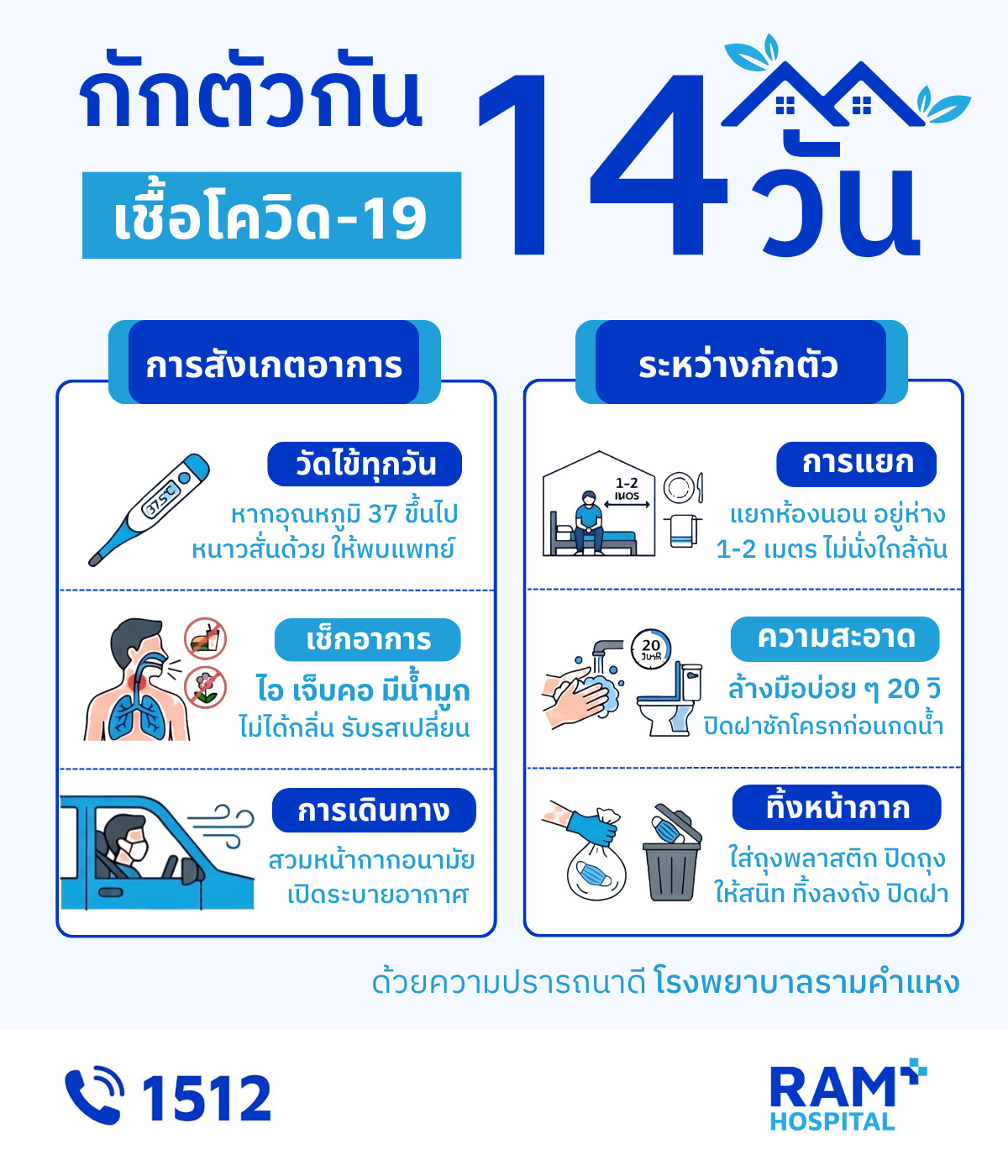
Guidelines for COVID-19 Patients During Home Isolation
- Separate rooms: Keep personal items separate from others. If full separation is impossible, maintain maximum distance and keep windows open for ventilation.
- Do not leave the residence: and do not allow visitors at home.
- Do not approach or stay close to others: Maintain a physical distance of at least 2 meters.
- Wear a face mask at all times: when not alone.
- Wash hands with soap or alcohol gel: every time after touching shared or personal objects.
- Do not dine with others:
- Wash clothes and bedding separately: using soapy water or detergent. Use a separate bathroom if possible, and dispose of trash separately by tying trash bags tightly.
Essential Items Needed
Important devices to keep on hand for initial health monitoring:
- Medical Thermometer: To track body temperature changes and record them daily.
- Fingertip Pulse Oximeter: This assesses gas exchange in the lungs. Normal readings are around 97-100%. If readings reach 94% or lower, monitor closely, as it indicates a tendency of COVID moving into the lungs. Healthcare staff and doctors will monitor via telemedicine continuously while resting at home.
- If symptoms worsen, an ambulance will pick up the patient and transfer them to the hospital immediately.
Support Provided to COVID-19 Patients During Home Isolation
- Three daily meals and symptom monitoring: along with medical consultations.
- Monitoring devices: including a thermometer and a fingertip pulse oximeter to assess pulmonary gas exchange. Normal levels range from 97-100%. Readings of 94% or lower require close observation as it suggests COVID-19 may have affected the lungs.
- Daily assessment via Telemedicine: technology allowing patients and medical personnel to interact in real-time with doctors and nurses every day.
- Daily medication supply: evaluated based on symptoms and at the doctor's discretion.
- If symptoms change or worsen, notify the medical team: for prompt transfer to the hospital.
Recommendations for Daily Routine and Work
It is essential to continuously monitor your symptoms and measure body temperature daily. If symptoms worsen—such as panting, fatigue, high fever, or inability to perform daily activities—contact your attending hospital immediately. The hospital will dispatch an ambulance to transport you for admission. If you must travel to the hospital by yourself, it is recommended to use a private vehicle, wear a mask at all times, and open car windows for better ventilation if others are present.
Medications to Avoid for Patients with Pre-existing Conditions Awaiting Hospital Beds
While hospitalized patients receive close medical supervision, patients under Home Isolation may not be aware of which medications to avoid during COVID-19 infection. There are 2 main groups to watch out for:
1. Diabetic Patients (Awaiting Hospital Bed)
Basic care involves regular blood sugar monitoring. If blood sugar is high, previously prescribed medication can be taken as usual. However, if blood sugar is already low, insulin or oral diabetes medications should be paused temporarily, as low blood sugar during COVID-19 is particularly dangerous.
2. Patients Taking Diuretics
If fluid intake is low, diuretics should be paused or reduced. Increased urination without adequate fluid replenishment can lead to fatigue and dehydration. Combined with a fever, the body consumes more energy, leading to even greater exhaustion.
Home Isolation is an alternative option for asymptomatic patients who have been evaluated and approved by a doctor for home isolation.
Information and images courtesy of: Department of Medical Services, Ministry of Public Health