
TANAWIS JAMNEANKAL, M.D.
CHILD AND ADOLESCENT PSYCHIATRY



‘Childhood Nightmares’ are an occasional occurrence in every household. Dreams often happen while we sleep in total darkness. These dreams can feel startlingly real, causing children to panic and cry out in the dark before everything vanishes when the room light is turned on. Essentially, the entire family ‘loses sleep,’ making it a nightmare for everyone involved.
‘World Sleep Day’ falls on the second Friday of March every year. If we combine science with ancient beliefs, we might see a secret code that has long linked humanity. March represents Pisces, the ruler of imagination, fantasy, and escapism. Neptune (♆) is its governing planet, and its trident symbol bears a striking, coincidental resemblance to the symbol of Psychology (Ψ).
As if to tell us that the world of dreams and our minds are as vast and mysterious as the ocean.
While the body slumbers, the emotional center of the brain known as the ‘Amygdala’ may become hyperactive, creating frightening simulations. This occurs especially during REM Sleep (Rapid Eye Movement), which usually happens in the latter half of the night. The dreams feel so vivid that children wake up in terror, with the memories etched deeply into their minds.
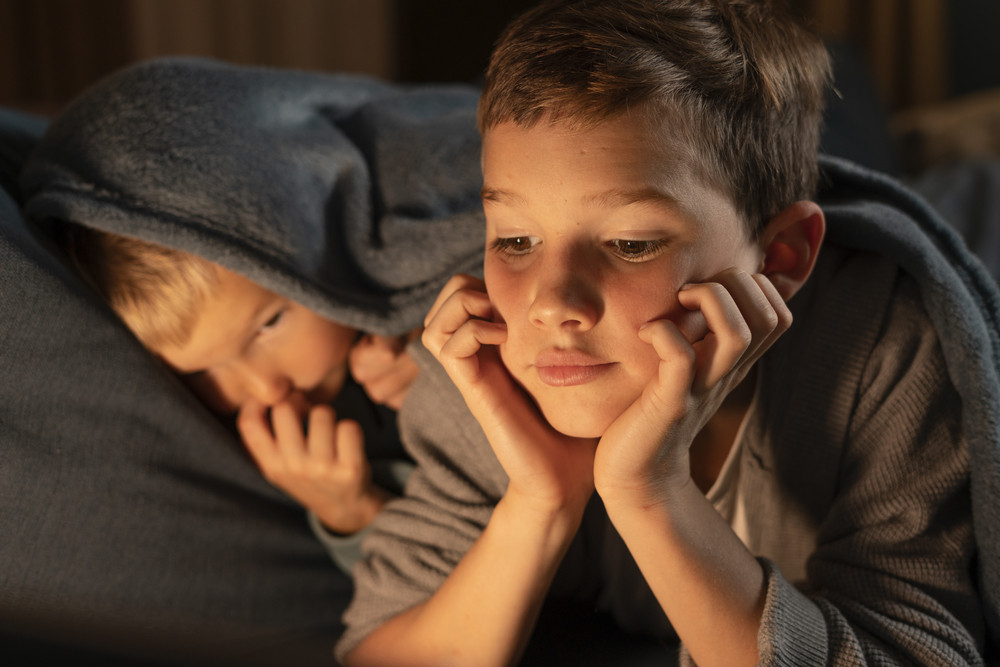
For young children, nightmares often stem from an imagination that still struggles to distinguish reality, sometimes triggered by scary movies or books before bed. For teenagers, cumulative stress or major life transitions are often contributing factors. Their fear isn't just about the vast emptiness, but also a deep, dark descent into a sense of isolation.
Sometimes, children may experience "Night Terrors," which differ from nightmares. They usually occur during deep sleep early in the night; the child may scream but remains asleep and typically has no memory of the event the next morning.
We often view darkness as a symbol of nightmares or evil, but physiologically, “Darkness is beautiful” and is a crucial factor for growth.
If nightmares occur so frequently that they affect daily life—causing a fear of bedtime, daytime fatigue, or constant nighttime distress—it might be ‘Nightmare Disorder.’ The role of a child psychiatrist at Ramkhamhaeng Hospital is like a guide who helps ignite a light in a child's heart, shining through the dark even if that light is invisible to the eye.
We are often taught to fear the dark and wait only for the light... but have you noticed that the 'shining stars' appear most beautiful only when the sky is pitch black? Equally important is ‘a parent's loving embrace’ to help our children reside beautifully in the dark. Perhaps we don't fear the darkness itself, but rather being alone in it. If there is someone by our side, “The darkness can be magnificent,” just like the songs we dream of, both while asleep and awake.
CHILD AND ADOLESCENT PSYCHIATRY

Pediatrics, Pediatric Pulmonology

Pediatrics Pediatric Endocrinology and Metabolism

Pediatrics


