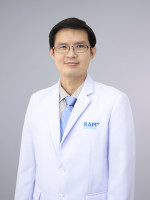
นพ. RATTANARAT INTARAT, M.D.
Neurological Surgery



“ While sitting and working, a sharp headache suddenly struck. I've had headaches before, but never this severe. I tried taking paracetamol pain relievers as usual, but why didn't it go away this time? After work, I went straight to see a doctor. After examination, nothing abnormal was found. I received extra medication, but it still didn't help... What on earth is happening to me? Could it be a mental illness...?”
This is what many patients tell me. Based on their history, it is quite clear that this is an unusual headache because medication does not relieve or improve it. However, it is not easy to immediately tell whether the cause of your headache is a ruptured pituitary tumor. But if the headache comes on suddenly and severely, accompanied by nausea, vomiting, blurred vision, poor eyesight, and double vision, it is quite easy to suspect that the patient may have bleeding in a pituitary tumor, known as Pituitary apoplexy.
Bleeding in a pituitary tumor is statistically quite rare. We only encounter this condition in about 1-10%, depending on the size of the tumor, with larger tumors having a higher chance of occurrence. Although it is not the most common primary symptom of a pituitary tumor, it is a condition that causes patients to suffer greatly from severe headaches and can be life-threatening if not treated promptly.
The pituitary gland in medical terms, we use the word pituitary gland. "Pituitary" comes from Latin, meaning "mucus," because, back then, it was thought that this gland produced mucus that flowed down through the nose. When asked about the appearance of this gland, I would like you to imagine a red bean seed placed deep inside the nose, right between the two eyes, at the center of the head, at the base of the skull. Importantly, in that very small area,
there are important surrounding structures, such as the optic nerves, the major cerebral arteries supplying the brain, and cranial nerves III, IV, V, and VI. These structures act like a house wall surrounding the pituitary gland.
The pituitary gland is responsible for producing various hormones, such as ACTH, Growth hormone, Thyroid hormone, and sex hormone. The important functions of these hormones are:

Pituitary tumor is an abnormal change in pituitary cells that causes a tumor to grow larger. In medicine, this type of tumor is generally found in about 10% of all brain tumors. If the size of the pituitary tumor is greater than 1 cm, we call it a Macropituitary adenoma. Notice that a tumor in this location exceeding 1 cm is considered very large. Conversely, if it is less than 1 cm, it is called a Micropituitary adenoma. Interestingly, most of these tumors are benign, not malignant, and grow slowly. A pituitary tumor can cause symptoms in two main ways:
The first type, which causes hormone abnormalities, presents with diverse symptoms depending on which hormone is abnormally elevated, creating specific syndromes.
The other type does not increase hormone levels, but instead causes symptoms due to the large size of the tumor compressing nearby vital organs, especially the optic nerves. This causes patients to visit a doctor because of
In addition to these two main symptom types, there is the special, less common but more severe condition I mentioned at the beginning: symptoms of pituitary tumor bleeding (Pituitary apoplexy).


Of course, pituitary tumors can be treated. The good news about this disease is that most cases are discovered incidentally through brain MRI scans, and they are usually small and asymptomatic. There is a term for this situation: we call this type of pituitary tumor an "Incidentaloma." In this group, the treatment approach is certainly to monitor abnormal symptoms and whether the tumor size increases. If it grows larger, definitive treatment plays a role. However, for groups that already have symptoms, treatment is necessary, depending primarily on what the main symptom is.
We must examine closely which hormone is elevated. If it is a prolactinoma, whose prominent symptom is inappropriate lactation, this group of tumors can be treated and shrunk with medication. Prolactinoma tumors can be treated with medication to shrink them without surgery. However, for tumors dominated by other hormones, surgery plays a role.
The key principle for operating on hormone-secreting pituitary tumors is that the tumor must be completely removed; Otherwise, the abnormally high hormone levels will not decrease, and symptoms will not resolve. Moving on to the other main symptom group:
The Surgical treatment can reduce pressure on the optic nerves, giving vision a chance to return to normal. However, a slight caution is needed here: if the tumor has compressed the optic nerves for a long time, the chance of the optic nerves being permanently damaged beyond recovery is quite high. Therefore, ideally, do not let yourself go blind before seeking medical examination.
As mentioned above, this tumor is located at the base of the skull, which is the center of the head. This allows surgery to be approached from above through the skull, meninges, and brain down to the skull base to remove the tumor, or from below through the nostrils or gums and through the nasal cavity to the skull base using a high-magnification surgical microscope.
In tumors with higher-than-normal aggressiveness—whose appearance on MRI looks ferocious due to invasion into surrounding vital organs—complete surgical removal is quite difficult. Therefore, in these cases, radiation therapy may be necessary to reduce the chance of tumor recurrence.


Source: Thank you for the images from Dr. Napasin Thekingdej, Neurosurgeon
A tumor arising in a tiny part of the brain, yet requiring a large medical team to treat.
RAM Pituitary Endoscopic Surgery Center, Ramkhamhaeng Hospital
(RAM Pituitary Center)
"RAM Pituitary Center at Ramkhamhaeng Hospital is ready to provide care and treatment for pituitary tumor patients through collaboration between neurosurgeons and ENT specialists, combining surgical science with medical technology to increase the safety of brain tumor surgery and help patients return to normal life."

As is well known, the Neurosurgery Department of Ramkhamhaeng Hospital, led by Professor Emeritus Dr. Sira Boonyaratvej, a neurosurgery professor, has collaborated with the ENT Department in treating pituitary tumor patients for a long time, until a major turning point occurred.
In 2005 (2548 Thai Era), Dr. Phuriphan Aramwattanapong, an ENT specialist, began introducing endoscopes into surgeries to replace traditional surgical approaches through the sublabial or nasal septal routes.
Later in 2015 (2558 Thai Era), Dr. Napasin Thekingdej, a neurosurgeon, joined the surgical team at Ramkhamhaeng Hospital and continued the approach of endoscopic pituitary tumor surgery. This allowed the surgical team to continuously modernize their techniques while receiving technological support from the hospital, resulting in excellent feedback from treating patients with this technique.
Ultimately, the surgical teams from both departments decided that the time had come to establish the RAM Pituitary Center, emphasizing the strong cooperation between both departments in providing curative treatment for pituitary tumor patients with maximum safety, combining the expertise of doctors from both specialties with modern surgical equipment forever.

Doctors choose the Endoscopic Endonasal approach because this technique provides surgeons with a wider and more comprehensive view of critical areas, allowing for greater surgical precision and safety (as shown in the image). With this method, patients have no external scars, experience very minimal postoperative pain, recover quickly, and require only a short hospital stay. Additionally, our center utilizes a Neuronavigator system to create virtual 3D models of the patient, helping guide position and direction during surgery—much like a GPS navigation system for surgeons to enhance patient safety a step further.


Many may not know that successfully treating a pituitary tumor requires more than just a surgeon; in fact, it requires a collaborative team of up to 8 departments working together to give patients the best chance of recovery.


Example photos of patient cases treated via endoscopic pituitary surgery by Dr. Napasin Thekingdej and Dr. Phuriphan Aramwattanapong
Neurological Surgery

General Neurology and Vascular Neurologist

Neuro Med Subboard Stroke


