

The Diabetic Foot Care Center, Ramkhamhaeng Hospital, provides care and treatment for diabetic foot ulcers under the supervision of a team of doctors and medical personnel specialized in diabetes and wound care. We are committed to treating diabetic patients with advanced technologies and methods to reduce the risk of ulcer progression and support recovery.
In Addition, the center offers consultation on foot care to prevent future complications.


The management of diabetic foot ulcers requires offloading the wound by using appropriate therapeutic footwear, daily saline or similar dressings to provide a moist wound environment, debridement when necessary, antibiotic therapy if osteomyelitis or cellulitis is present, optimal control of blood glucose, and need evaluation and correction of peripheral arterial insufficiency.
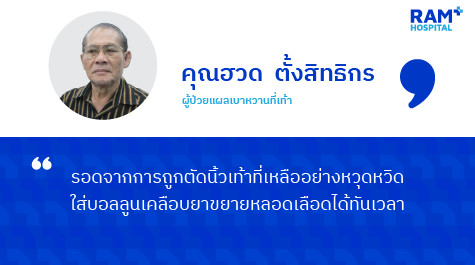
"Mr. Huat Tang Sittikorn, who is 71 years old, told me that he had diabetes for 37 years. While the foot wound just happened a few years ago, with his daughter Ms. Siriporn helping to burden him. Taking care of the wound itself, brought him to the clinic and hospital. At first, the wound was only on the thumb but it treats for a year and still hasn't healed. And there are still more wounds until 4 toes have been amputated and the wound is beginning to spread to the fifth finger."
His relatives were seen on TV shows that at Ramkhamhaeng Hospital, there is a technique to widen blood vessels to help heal diabetic wounds. Therefore hurriedly brought him to contact for treatment immediately.
After Dr. Suthat accepted him for a thorough examination. Explained that it is caused by veins in the legs, which means the end of the blood vessel is blocked causing the blood to not flow to the toe. Therefore causing the wound that occurs that cannot be healed And the nerves in that area will not be perceived. He does not feel pain in the wound. And brought him to the color injection to see the condition of the peripheral vascular. It was found that the stenosis area was below the knee, and his veins or blood vessels had already become completely blocked by 2 of the 3 and the remaining ones were clogged at intervals. Includes 2 positions, each of which is 8 cm and 12 cm long.
Our doctors inserting the balloon into the blood vessels up to the constricted position and pumping air into it, inflating the balloon all around, resulting in immediate inflation of the blocked blood vessel, allowing blood to reach the toe. In time to survive the amputation of the remaining toe.
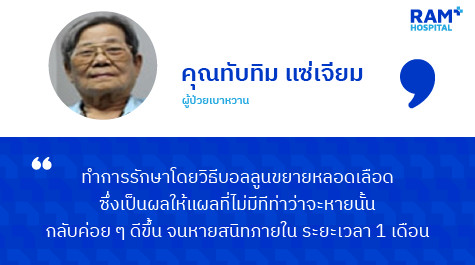
She had been living with diabetes for over 20 years and had previously developed a chronic foot ulcer that failed to heal, eventually requiring the amputation of four toes.
Not long afterward, a small red spot appeared on the sole of his foot, resembling a mosquito bite, which later developed into a wound. Despite regular cleaning and wound care, there were no signs of healing.
Approximately 6–7 months later, the affected toe became swollen and red, and his mother noticed that she was experiencing pain in the toe. She then took him to see a physician at Ramkhamhaeng Hospital.
After evaluation, the physician explained that the condition was caused by peripheral arterial disease. Treatment was performed using balloon angioplasty to dilate the narrowed blood vessels. As a result, the previously non-healing wound gradually improved and completely healed within one month.
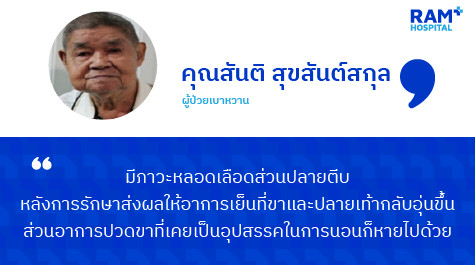
He had been living with diabetes for many years when he suddenly began to experience leg pain. When he touched his leg and toes, he noticed that they felt abnormally cold, as if standing on ice. Even using an electric blanket provided no relief.
These symptoms occurred mostly at night, preventing him from sleeping and forcing him to rely on sleeping medication every night. Eventually, his daughter, who was his primary caregiver, could no longer bear to see him suffer and took him to consult a physician at Ramkhamhaeng Hospital.
After examination, he was diagnosed with peripheral arterial disease. Following treatment, the cold sensation in his legs and toes improved, becoming warm again, and the leg pain that had interfered with his sleep completely resolved.
 "แผลเบาหวาน" ที่เกิดจากหลอดเลือดตีบตัน
 "แผลเบาหวานที่เท้า"...รักษาได้!
 สาเหตุการเกิดภาวะแทรกซ้อน จากแผลเบาหวาน
 เทคโนโลยีการรักษาแผลเบาหวานที่เท้า
 นวัตกรรมการรักษาแผลเบาหวานที่เท้า

 เส้นเลือดขอด
 แผลเบาหวานที่เท้า
 นวัตกรรมการรักษาแผลเบาหวานที่เท้า
 เบาหวานภัยที่มากับน้ำท่วม
 แผลเบาหวานที่เท้า โรคที่มากับน้ำท่วม
 ภาวะแทรกซ้อนโรคเบาหวานที่เท้า
 อันตรายของแผลเบาหวานที่เท้า
 การรักษาภาวะหลอดเลือดส่วนปลายตีบ
 โรคแทรกซ้อนจากแผลเบาหวานที่เท้า

"Mr. Huat Tang Sittikorn, who is 71 years old, told me that he had diabetes for 37 years. While the foot wound just happened a few years ago, with his daughter Ms. Siriporn helping to burden him. Taking care of the wound itself, brought him to the clinic and hospital. At first, the wound was only on the thumb but it treats for a year and still hasn't healed. And there are still more wounds until 4 toes have been amputated and the wound is beginning to spread to the fifth finger."
His relatives were seen on TV shows that at Ramkhamhaeng Hospital, there is a technique to widen blood vessels to help heal diabetic wounds. Therefore hurriedly brought him to contact for treatment immediately.
After Dr. Suthat accepted him for a thorough examination. Explained that it is caused by veins in the legs, which means the end of the blood vessel is blocked causing the blood to not flow to the toe. Therefore causing the wound that occurs that cannot be healed And the nerves in that area will not be perceived. He does not feel pain in the wound. And brought him to the color injection to see the condition of the peripheral vascular. It was found that the stenosis area was below the knee, and his veins or blood vessels had already become completely blocked by 2 of the 3 and the remaining ones were clogged at intervals. Includes 2 positions, each of which is 8 cm and 12 cm long.
Our doctors inserting the balloon into the blood vessels up to the constricted position and pumping air into it, inflating the balloon all around, resulting in immediate inflation of the blocked blood vessel, allowing blood to reach the toe. In time to survive the amputation of the remaining toe.
She had been living with diabetes for over 20 years and had previously developed a chronic foot ulcer that failed to heal, eventually requiring the amputation of four toes.
Not long afterward, a small red spot appeared on the sole of his foot, resembling a mosquito bite, which later developed into a wound. Despite regular cleaning and wound care, there were no signs of healing.
Approximately 6–7 months later, the affected toe became swollen and red, and his mother noticed that she was experiencing pain in the toe. She then took him to see a physician at Ramkhamhaeng Hospital.
After evaluation, the physician explained that the condition was caused by peripheral arterial disease. Treatment was performed using balloon angioplasty to dilate the narrowed blood vessels. As a result, the previously non-healing wound gradually improved and completely healed within one month.
He had been living with diabetes for many years when he suddenly began to experience leg pain. When he touched his leg and toes, he noticed that they felt abnormally cold, as if standing on ice. Even using an electric blanket provided no relief.
These symptoms occurred mostly at night, preventing him from sleeping and forcing him to rely on sleeping medication every night. Eventually, his daughter, who was his primary caregiver, could no longer bear to see him suffer and took him to consult a physician at Ramkhamhaeng Hospital.
After examination, he was diagnosed with peripheral arterial disease. Following treatment, the cold sensation in his legs and toes improved, becoming warm again, and the leg pain that had interfered with his sleep completely resolved.