

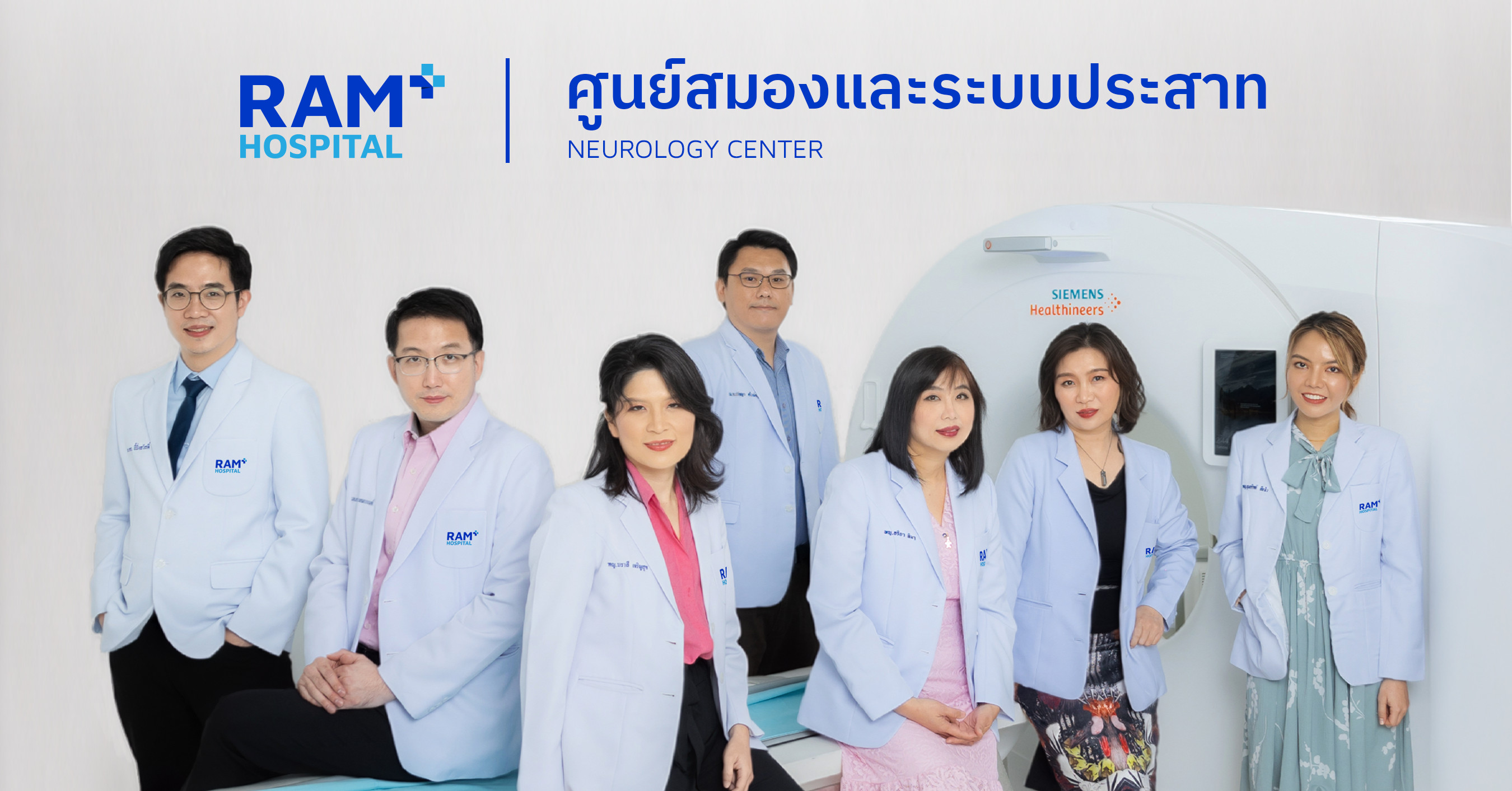
Our neurology center provides comprehensive diagnosis, treatment, and rehabilitation for disorders of the nervous system, brain, and spinal cord. Our expert neurologists and neurosurgeons use innovative technology to detect and address abnormalities, preventing potential disability or death, and ensuring the highest quality care.
This center offers specialized treatment for strokes, which can result in symptoms like paresis or paralysis. Additionally, our Stroke Fast Track system provides prompt support to stroke patients who experience symptoms within 4.5 hours. Our team of specialist doctors are well-equipped to provide comprehensive care for these conditions :

In addition to specialized clinics, the Neurology Center, Ramkhamhaeng Hospital also provides a range of other services for patients suffering from other brain and nervous system diseases, such as :
The Neurology Center at Ramkhamhaeng Hospital is composed of a team of highly skilled neurosurgeons who specialize in treating and advising patients with neurological disorders of the brain and spinal cord that require surgical intervention. The hospital is equipped with advanced surgical technology including microscopes, endoscopes, and navigators. Our care and treatment includes conditions such as :
The Neurology Center at Ramkhamhaeng Hospital provides a range of equipment used in the diagnosis and treatment of brain and nervous system diseases. These include advanced technologies for diagnosing and treating disorders of the nervous system, brain, and spinal cord, such as :
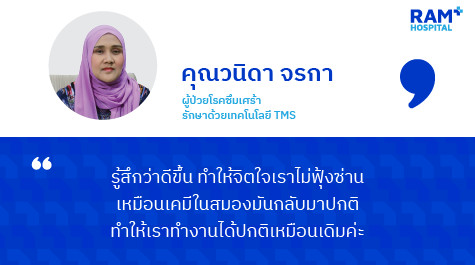
Former Depression Patient Treated with TMS Technology
"I feel so much better; I want to eat, and I can sleep. My mind isn't racing, and I don't have headaches. It's like my brain chemistry is back to normal, allowing me to work and take care of my mother and do housework as usual."
My symptoms started in November 2018. I couldn't handle it anymore: my hands trembled, my heart pounded, I couldn't sleep or eat. I went to a clinic, where the doctor prescribed up to 15 sleeping pills, but even after taking 5, I still couldn't sleep. My family told me to stop taking them. Later, I started feeling scared, unable to drive because my heart would race and I'd sweat. From January 2019, I couldn't drive. I had severe headaches, shoulder and neck pain, body aches, and felt like my head would explode. I didn't want to live and avoided everyone because I felt useless, unable to care for my mother after leaving my job to do so. This feeling made me not want to exist.
My mother was already a patient of Dr. Ariya. I asked her about my condition, and she suggested trying TMS (Transcranial Magnetic Stimulation), hoping it would help. So, around late July, I saw Dr. Ariya. I was ill with a severe fever and headache, so I was admitted to the hospital for 3-4 days. On the second day, I received TMS treatment and felt better immediately; I could eat and sleep. On the third day, I had another session and improved further. The doctor also mentioned prescribing a stimulant.
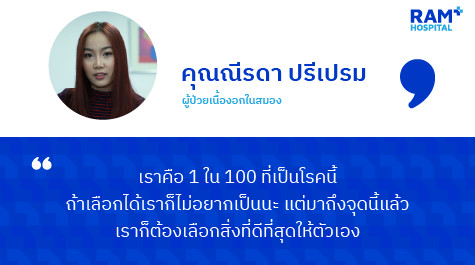
Former Brain Tumor Patient's Journey
"The word 'tumor' felt so distant, especially being so young. I thought, 'Do I have a tumor?'" said Ms. Neerada Preeprem, a 24-year-old former brain tumor patient. At her age, the odds of developing a tumor are only 1 in 100.
After experiencing frequent dizziness, visiting multiple hospitals, and finding no relief from medication, Ms. Preeprem developed sharp, intermittent headaches for 5-6 consecutive days, rendering her unable to sleep or work. She sought treatment at Ramkhamhaeng Hospital.
Initially, I received medication for a suspected migraine, as other tests showed no abnormalities, and it was attributed to my lifestyle. However, my condition didn't improve, so I returned to the doctor. This time, I was sent for an MRI, which revealed a tumor on my pituitary gland."
Learning this was a shock, and many thoughts flooded her mind. The doctor explained the treatment options: surgery or medication. Ms. Preeprem initially favored medication due to her fear of surgery, specifically the thought of brain penetration and the daunting image of an operating room with orange lights and blood-stained green drapes. However, medication meant lifelong treatment and only shrinking the tumor, not removing it. She requested time to decide and consult her family. The doctor respected her decision, understanding her fear.
Ultimately, she chose surgery. The doctor clarified that it wasn't the invasive procedure she imagined; it was endoscopic surgery through the nose, leaving only a small incision. Before the surgery, the doctor conducted thorough examinations, which, while extensive, reassured her of their meticulous care. The operating room environment was not as intimidating as she had pictured; the medical staff were smiling and attentive. After anesthesia, she woke up feeling no pain and was pleasantly surprised; her fear of surgery was gone. She recovered in just two nights and was discharged. Post-surgery care involved minor attention to the nasal incision, which healed completely in less than 15 days.
Many questioned her choice of hospital. She confidently stated, "This hospital has excellent equipment and skilled doctors, ensuring no waiting for treatment—some things can't wait, right? The service here is also exceptional; the doctors, nurses, and even the staff took great care of me. If I pay a little more and get such good results—a new life—I'm willing to pay."
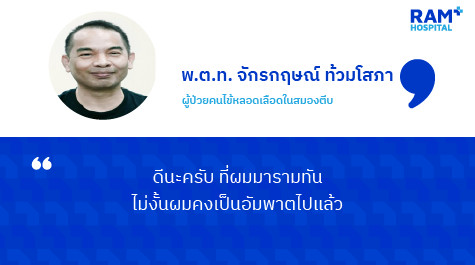
Former Stroke Patient's Account
"While traveling, I experienced constant dizziness that progressively worsened. Upon arrival at the hospital, I first saw an ENT specialist who checked for fluid balance in my ears; the results were normal. Fortunately, the doctor suspected something more and referred me to a neurologist. The neurologist determined my blood pressure was elevated, and I had a slight facial droop, leading to an immediate MRI. The scan revealed a cerebrovascular issue requiring urgent treatment. The doctor explained the treatment, and once I agreed, they administered a clot-dissolving drug immediately. Within six hours, my dizziness subsided. I'm incredibly fortunate that I arrived in time and that the doctors provided such attentive care; otherwise, I would have been paralyzed."
Early Detection is Key
Police Lieutenant Colonel Jakkrit's case is exceptionally fortunate because he recognized his symptoms and sought prompt medical attention. If the brain is deprived of blood for more than three hours, the chances of a full recovery significantly decrease. Therefore, everyone must monitor their symptoms and those of their loved ones.
Do not ignore symptoms such as sudden weakness or numbness on one side of the body, slurred speech, loss of balance, decreased vision, or even temporary dizziness, tingling in the hands, or weakness that resolves on its own. These could be signs of a transient ischemic attack (TIA), which often precedes a full-blown stroke. If you experience any of these symptoms, seek immediate medical attention.
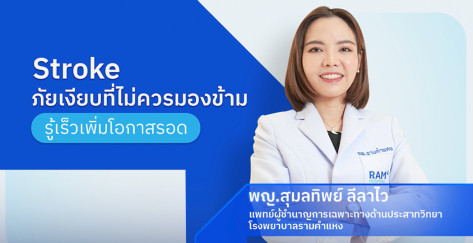
 Stroke ภัยเงียบ ที่ไม่ควรมองข้าม รู้เร็วเพิ่มโอกาสรอด
 วูบ หน้ามืด หมดสติ รู้ทันอันตราย ก่อนสายเกินแก้
 ก๊าซหัวเราะ ภัยเงียบที่แฝงมาพร้อมรอยยิ้ม
 งานสัมมนา "เคล็ด (ไม่) ลับ ดูแลสมอง ป้องกันสมองเสื่อมและพาร์กินสัน"
 Fiber Tracking เทคโนโลยี ที่ช่วยให้การผ่าตัดเนื้องอกในสมองปลอดภัยขึ้น
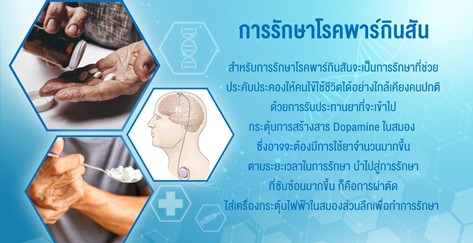
 โรคพาร์กินสัน
 ปวดหัวบ่อย ปวดนาน กินยาแก้ปวดก็ยังไม่หาย อาจเสี่ยงเป็น "โรคไมเกรน"
 รู้จักและเข้าใจ "โรคอัลไซเมอร์”
 ปวดศีรษะจากความเครียด
 ทำไงดี? อยากนอนหลับ แต่นอนไม่หลับ
 ปวดหัวเรื้อรัง สาเหตุเกิดจากอะไร?
 หากเกิดอาการชัก มีวิธีรับมืออย่างไร?
 ภาวะหลอดเลือดตีบที่คอ รู้เร็ว-รักษาได้
 วัคซีนโควิด-19 กับโรคทางระบบสมอง
 พาร์กินสัน โรคทางสมองที่ไม่ใช่แค่อาการสั่น
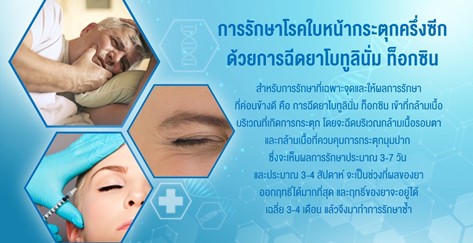
 โรคใบหน้ากระตุกครึ่งซึก
 การป้องกันหลอดเลือดสมองตีบควรปฎิบัติตัวอย่างไร?บ้าง
 แขน ขา อ่อนแรง อาการสัญญาณเตือนนี้ กำลังบอกอะไร?
 สัญญาณเตือนของอาการปวดศีรษะเรื้อรัง
 โรคสมองเสื่อมแท้และโรคสมองเสื่อมเทียม
 โรคซึมเศร้า กับการรักษาด้วยเทคโนโลยี TMS
 โรคหลอดเลือดตีบที่คอ

 การรักษาผู้ป่วยที่ได้รับบาดเจ็บที่ศีรษะ
 การดูแลผู้ป่วยที่บาดเจ็บทางศีรษะจากอุบัติเหตุ
 ภาวะน้ำคั่งในโพรงสมอง
 ชาจากปลายประสาท
 โรคชาจากสมอง
 วิธีรักษาอัมพฤกษ์ อัมพาต
 ออฟฟิศซินโดรม
 โรคลมชักหรือลมบ้าหมู
 โรคออฟฟิศซินโดรม
 โรคอัมพฤกษ์ อัมพาต
 การรักษาโรคออฟฟิศซินโดรม ด้วยเทคโนโลยีคลื่นแม่เหล็กไฟฟ้า
 ความเสี่ยงและอันตรายจากการออกกำลังกายหักโหม
 TMS เทคโนโลยีคลื่นแม่เหล็กไฟฟ้า
 อาหารเสริมเป็นพิษ
 ปวดหัวบ่อยอาจเสี่ยงโรคเนื้องอกในสมอง

Former Depression Patient Treated with TMS Technology
"I feel so much better; I want to eat, and I can sleep. My mind isn't racing, and I don't have headaches. It's like my brain chemistry is back to normal, allowing me to work and take care of my mother and do housework as usual."
My symptoms started in November 2018. I couldn't handle it anymore: my hands trembled, my heart pounded, I couldn't sleep or eat. I went to a clinic, where the doctor prescribed up to 15 sleeping pills, but even after taking 5, I still couldn't sleep. My family told me to stop taking them. Later, I started feeling scared, unable to drive because my heart would race and I'd sweat. From January 2019, I couldn't drive. I had severe headaches, shoulder and neck pain, body aches, and felt like my head would explode. I didn't want to live and avoided everyone because I felt useless, unable to care for my mother after leaving my job to do so. This feeling made me not want to exist.
My mother was already a patient of Dr. Ariya. I asked her about my condition, and she suggested trying TMS (Transcranial Magnetic Stimulation), hoping it would help. So, around late July, I saw Dr. Ariya. I was ill with a severe fever and headache, so I was admitted to the hospital for 3-4 days. On the second day, I received TMS treatment and felt better immediately; I could eat and sleep. On the third day, I had another session and improved further. The doctor also mentioned prescribing a stimulant.
Former Brain Tumor Patient's Journey
"The word 'tumor' felt so distant, especially being so young. I thought, 'Do I have a tumor?'" said Ms. Neerada Preeprem, a 24-year-old former brain tumor patient. At her age, the odds of developing a tumor are only 1 in 100.
After experiencing frequent dizziness, visiting multiple hospitals, and finding no relief from medication, Ms. Preeprem developed sharp, intermittent headaches for 5-6 consecutive days, rendering her unable to sleep or work. She sought treatment at Ramkhamhaeng Hospital.
Initially, I received medication for a suspected migraine, as other tests showed no abnormalities, and it was attributed to my lifestyle. However, my condition didn't improve, so I returned to the doctor. This time, I was sent for an MRI, which revealed a tumor on my pituitary gland."
Learning this was a shock, and many thoughts flooded her mind. The doctor explained the treatment options: surgery or medication. Ms. Preeprem initially favored medication due to her fear of surgery, specifically the thought of brain penetration and the daunting image of an operating room with orange lights and blood-stained green drapes. However, medication meant lifelong treatment and only shrinking the tumor, not removing it. She requested time to decide and consult her family. The doctor respected her decision, understanding her fear.
Ultimately, she chose surgery. The doctor clarified that it wasn't the invasive procedure she imagined; it was endoscopic surgery through the nose, leaving only a small incision. Before the surgery, the doctor conducted thorough examinations, which, while extensive, reassured her of their meticulous care. The operating room environment was not as intimidating as she had pictured; the medical staff were smiling and attentive. After anesthesia, she woke up feeling no pain and was pleasantly surprised; her fear of surgery was gone. She recovered in just two nights and was discharged. Post-surgery care involved minor attention to the nasal incision, which healed completely in less than 15 days.
Many questioned her choice of hospital. She confidently stated, "This hospital has excellent equipment and skilled doctors, ensuring no waiting for treatment—some things can't wait, right? The service here is also exceptional; the doctors, nurses, and even the staff took great care of me. If I pay a little more and get such good results—a new life—I'm willing to pay."
Former Stroke Patient's Account
"While traveling, I experienced constant dizziness that progressively worsened. Upon arrival at the hospital, I first saw an ENT specialist who checked for fluid balance in my ears; the results were normal. Fortunately, the doctor suspected something more and referred me to a neurologist. The neurologist determined my blood pressure was elevated, and I had a slight facial droop, leading to an immediate MRI. The scan revealed a cerebrovascular issue requiring urgent treatment. The doctor explained the treatment, and once I agreed, they administered a clot-dissolving drug immediately. Within six hours, my dizziness subsided. I'm incredibly fortunate that I arrived in time and that the doctors provided such attentive care; otherwise, I would have been paralyzed."
Early Detection is Key
Police Lieutenant Colonel Jakkrit's case is exceptionally fortunate because he recognized his symptoms and sought prompt medical attention. If the brain is deprived of blood for more than three hours, the chances of a full recovery significantly decrease. Therefore, everyone must monitor their symptoms and those of their loved ones.
Do not ignore symptoms such as sudden weakness or numbness on one side of the body, slurred speech, loss of balance, decreased vision, or even temporary dizziness, tingling in the hands, or weakness that resolves on its own. These could be signs of a transient ischemic attack (TIA), which often precedes a full-blown stroke. If you experience any of these symptoms, seek immediate medical attention.
