
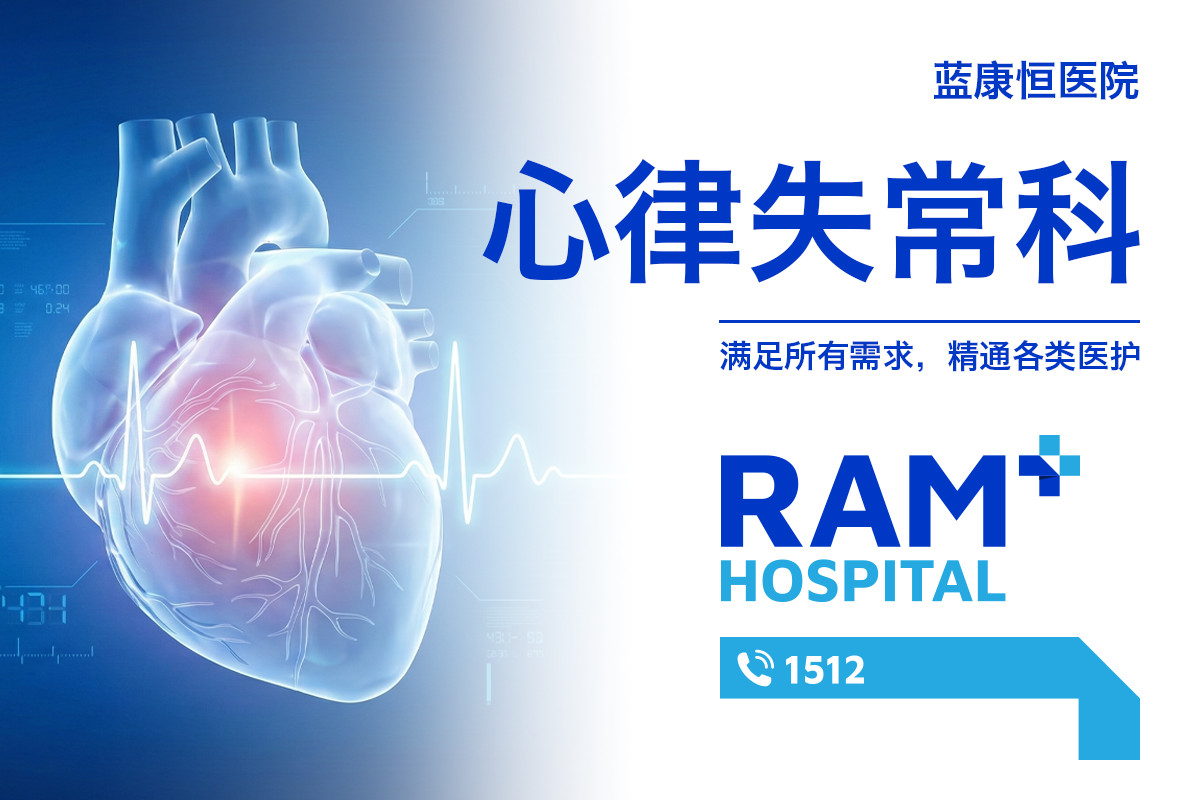
本院心律失常科由心脏电生理专科医师团队坐诊,于心脏电生理实验室开展诊疗工作,配备先进高效的医疗技术设备,可对各类心律失常患者进行全面的检查、诊断与治疗,助力医师精准分析病因并实施诊疗,力求实现最佳治疗效果。
CARTO 是一种能够呈现高精度三维图像的技术,可清晰显示心脏结构、心脏电活动及异常部位。所生成的图像会根据电信号传导的复杂程度呈现多种颜色,有助于医生更准确地诊断病情,降低并发症风险,并显著提高治疗的有效性。此外,CARTO 系统可与其他医疗设备协同工作,配套的设备包含:
CARTOSOUND 是一种超声系统,可与软件协同工作以生成三维图像,使医生能够清晰地观察心脏结构及异常部位的位置。
计算机断层扫描(CT)与类似GPS的导管定位系统相结合,以提高诊断和治疗的精准度。软件种类多样,可根据患者所患心律失常的具体类型,生成多种且更具针对性的图像,例如CFAEs(复杂碎裂心房电图),用于定位心脏中复杂的电信号活动。
电生理检查(Electrophysiology Study)是一种用于评估心脏电信号及其传导通路的检查方法,旨在通过二维图像显示结果,诊断心脏电系统异常的原因与具体位置,帮助医生选择合适的治疗方案。该方法使医生能够在诊断后立即进行高频射频导管消融治疗,实现诊断与治疗的无缝衔接。
使用高频射频能量消融心脏异常节律起源点,是指通过导管经血管插入至心腔内,导管末端带有电极可释放射频能量,以破坏电传导异常的部位。该过程借助心脏电生理标测系统(CARTO System)实时定位异常位置,并以三维图像实时显示。
该方法可用于治疗心脏电系统异常的疾病,尤其适用于异常起源点分布较广的病例,例如:
永久性心脏起搏器植入术 (pacemaker) 是将一个小型电子设备植入锁骨下方的皮下组织,并通过导线与心脏连接。该设备会持续监测心脏跳动节律,通过导线进行调控并按预设频率刺激心脏跳动。通常用于治疗患者出现异常心动过缓的情况。
植入型心律转复除颤器(implantable cardioverter defibrillator; ICD)是一种类似于起搏器的电子设备植入手术,通过导线连接至心脏。除可在心跳过缓时起搏心脏外,该除颤器还能在患者发生严重恶性心律失常(快速性心律失常)时提供治疗。
心脏再同步化治疗器械(CRT)植入术,是植入一款类似心脏起搏器或植入式心律转复除颤器(ICD)的电子器械,用于治疗经药物治疗后仍存在症状的慢性心力衰竭患者,该器械可调节心肌收缩节奏,实现心肌的同步舒缩。
蓝康恒医院心脏电生理实验室,配备有开展相关诊疗所需的各类医疗设备与器械。
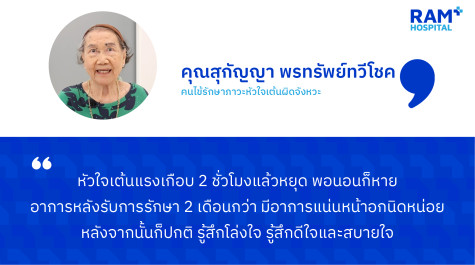
Arrhythmia Patient
“My heart would beat rapidly for almost 2 hours and then stop. Lying down helped. Over 2 months after receiving treatment, I experienced a slight chest tightness, but after that, everything returned to normal. I feel relieved, happy, and at ease.”
“My heart would beat rapidly for almost 2 hours and then stop. Lying down helped. This happened on and off for about 5 years. It wasn't frequent at first, but it got progressively worse later on. It could happen at any time, so I decided to see a doctor. The doctor diagnosed me with cardiac arrhythmia and said medication wouldn't cure it completely; I would have to take it for the rest of my life. The doctor suggested that cardiac ablation was the only way to be fully cured. I consulted another hospital, but they didn't have a direct ablation service and would have to bring in an external team, which made me hesitate. However, Ramkhamhaeng Hospital has specialized doctors and the technology for direct cardiac ablation. Over two months after the treatment, I had a slight chest tightness, but after that, everything was normal. I feel relieved, happy, and at ease.”
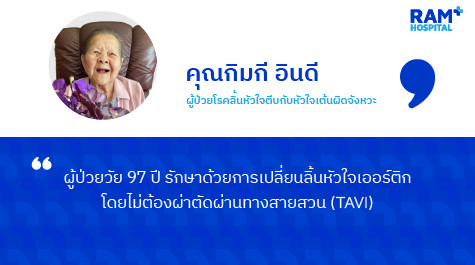
Aortic Valve Stenosis with Cardiac Arrhythmia
“A 97-year-old patient treated with Transcatheter Aortic Valve Implantation (TAVI), without open-heart surgery.”
“…During the period when COVID-19 began to spread more severely, ‘Khun Yai Kimki’ told her children and grandchildren to postpone doctor visits for the time being. However, after being away from medical care for about 7–8 months, she began to experience fainting episodes 3–4 times a week.
Her children and grandchildren, who were caring for her, took her to a nearby hospital as they felt it was an emergency and should not be delayed. Out of trust in Ramkhamhaeng Hospital, they contacted the hospital to seek treatment with Dr. Vichai Srimanus.
Upon arrival, she underwent a step-by-step diagnostic process, leading urgently to cardiac catheterization with contrast injection. This allowed the cause to be identified and continuous treatment to begin. It was determined that the underlying problems were aortic valve stenosis and cardiac arrhythmia.
Her daughter, Khun Phosri Indi
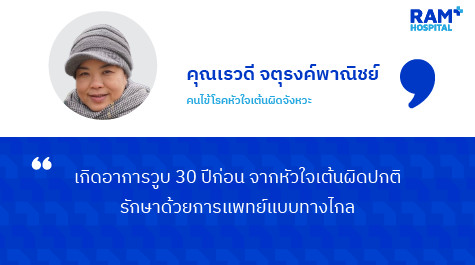
Patient with Arrhythmia
Experienced fainting 30 years ago due to abnormal heart rhythm; treated via telemedicine.
"...It happened when I was about 30. Initially, I just felt numbness at the base of my tongue and jaw. My heart would flutter, and I'd faint. I first went to Ramkhamhaeng Hospital, but they found nothing because I had no symptoms at the time, and the doctor thought it was just a regular faint. Then one day, I was riding on the back of a motorcycle in the village when I fainted and fell off. A neighbor saw it and took me to Ramkhamhaeng Hospital, where I met Dr. Wichai. He was suspicious because I was so young to have such symptoms. After a heart check-up, he had me wear a Holter monitor, which showed an abnormal heart rhythm. The doctor immediately called me back to the hospital for medication. After that, I improved and was told to take the medication daily. The doctor had initially said I might need to take medication for life to control my heart rate. After that, I fainted two or three more times, went back to the doctor, and received intravenous medication. I wondered what caused it, and the doctor explained that stress could be a factor. I thought that was probably it, as I had work problems and many other issues simultaneously. So, I decided to change my lifestyle, trying to eliminate all problems to avoid dwelling on them, and started exercising until I felt better. When I had no more fainting spells, I tried stopping the medication... I stopped for over 20 years and was fine, so I never saw a doctor again. I lived a normal life with no warning signs whatsoever. Then, suddenly, on February 28th, in the afternoon, I was walking in my room and just collapsed without any warning. Luckily, it was only for a moment. When I got up, I remembered my old symptoms. But after sitting all day, nothing else happened. Then, in the early evening, while leaning back watching TV, I felt faint and my heart pounded, and then I fainted repeatedly. I knew this was very unusual, much worse than before – I felt exhausted from the repeated fainting. So, I called an ambulance to take me to Ramkhamhaeng Hospital, knowing Dr. Wichai was still there, even after all these years. Although my medical records weren't there anymore, the doctor remembered me fainting and falling off the motorcycle. Dr. Wichai, along with Dr. Buncha, worked together to examine and treat me from that day on. They put a Holter monitor on me, but I didn't experience any symptoms..."
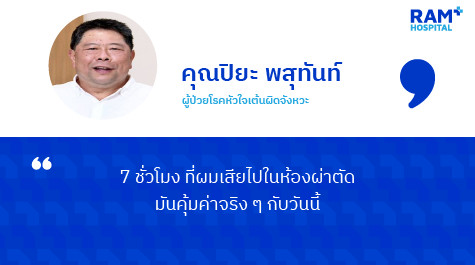
“After I had defibrillation implant surgery two years ago, I thought the severe symptoms from arrhythmia would be over. Able to travel abroad normally without worrying that symptoms will recur and possibly death at any time. But suddenly, an unexpected incident happened. When I have a heart disease that has arisen without knowing the cause !!
.
So I decided to come here. Upon examination, the heart was found to lack potassium. At first, the doctor prescribed potassium supplements. But it was never cured. Finally, the doctor recommends the treatment of electrolysis technology. Listening to it should help things get better. So I decided to do it."
Doctors have to tell you that this method is quite complex and can take a long time. The doctor doing the treatment must have great expertise, and the equipment must be ready. Because if an error occurs, the patient's heart can be damaged and die. For Mr. Piya, it takes up to 7 hours for the surgery by electrocautery. It can be treated in 2 large areas. And there are still 2 small points that cannot be operated on by electrocautery immediately. The doctor then considered the treatment for 2 points later.
After the surgery, Mr. Piya was able to live the same life. Because he follows the instructions strictly. With medication regularly. Reduce your stress from work. Get enough exercise and rest. Severe arrhythmias do not recur. Even if you have to travel abroad for 15 hours, symptoms will still be fine. We are glad to be a part of Piya's recovery from the symptoms. Make his life safer and more comfortable.
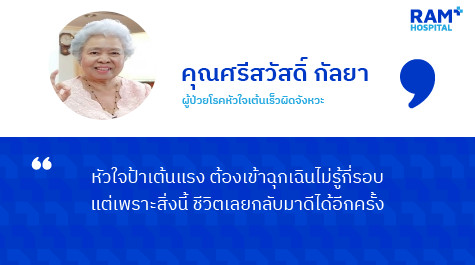
Former Arrhythmia Patient: Srisawat Kalaya's Story
Srisawat Kalaya visited the doctor experiencing "cardiac arrhythmia," or an abnormally fast heartbeat. He described the initial phase of his condition, which involved chest pain and easy fatigue. He sought medical attention, received medication, and felt better for a while. However, his symptoms would return intermittently, eventually becoming more frequent and prolonged, significantly impacting his daily life. There were times his heart would pound continuously from 8 AM to 2 PM. This led him to revisit his previous hospital, where doctors recommended radiofrequency ablation to treat the heart muscle.
Choosing Ramkhamhaeng Hospital for Treatment
When serious treatment became necessary, Srisawat and his family decided to transfer to Ramkhamhaeng Hospital. They were confident in the medical team's expertise and the hospital's advanced equipment. After a thorough re-diagnosis, the doctor recommended a treatment plan, and Srisawat chose to undergo catheter ablation to target the abnormal electrical impulses in his heart.
Swift Recovery and Normal Heart Rhythm
Srisawat's recovery was remarkably quick; he stayed at the hospital for only one night and was discharged the following morning. A week later, he had a follow-up appointment, and tests confirmed his heartbeat had returned to normal.
 เทคโนโลยีที่ช่วยในการรักษา โรคหัวใจเต้นผิดจังหวะ
 ภาวะหัวใจวายเฉียบพลันจากหัวใจเต้นผิดจังหวะ
 โรคหัวใจวายเฉียบพลันและภาวะหัวใจห้องบนเต้นพลิ้ว
 ภาวะหัวใจวายเฉียบพลัน
 การช่วยชีวิตผู้ป่วยหัวใจวายเฉียบพลัน ด้วยการทำ CPR อย่างถูกวิธี
 โรคหัวใจเต้นผิดจังหวะ AF
 หัวใจเต้นผิดจังหวะ ร้ายแรงแค่ไหน? ต้องดู
 โรคหัวใจเต้นผิดจังหวะ AF
 โรคหัวใจเต้นผิดจังหวะ AF
 โรคหัวใจเต้นผิดจังหวะชนิด AF
 โรคหัวใจเต้นผิดจังหวะ AF ทำให้เกิดหลอดเลือดสมองอุดตัน
 เราจะรู้ได้อย่างไรว่าเป็น ภาวะหัวใจเต้นผิดจังหวะ
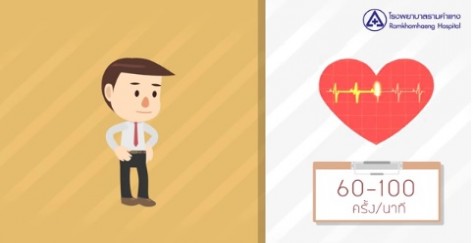 รายการเรื่องจริงผ่านจอ วิกฤตโรคหัวใจเต้นผิดจังหวะ

Arrhythmia Patient
“My heart would beat rapidly for almost 2 hours and then stop. Lying down helped. Over 2 months after receiving treatment, I experienced a slight chest tightness, but after that, everything returned to normal. I feel relieved, happy, and at ease.”
“My heart would beat rapidly for almost 2 hours and then stop. Lying down helped. This happened on and off for about 5 years. It wasn't frequent at first, but it got progressively worse later on. It could happen at any time, so I decided to see a doctor. The doctor diagnosed me with cardiac arrhythmia and said medication wouldn't cure it completely; I would have to take it for the rest of my life. The doctor suggested that cardiac ablation was the only way to be fully cured. I consulted another hospital, but they didn't have a direct ablation service and would have to bring in an external team, which made me hesitate. However, Ramkhamhaeng Hospital has specialized doctors and the technology for direct cardiac ablation. Over two months after the treatment, I had a slight chest tightness, but after that, everything was normal. I feel relieved, happy, and at ease.”
Aortic Valve Stenosis with Cardiac Arrhythmia
“A 97-year-old patient treated with Transcatheter Aortic Valve Implantation (TAVI), without open-heart surgery.”
“…During the period when COVID-19 began to spread more severely, ‘Khun Yai Kimki’ told her children and grandchildren to postpone doctor visits for the time being. However, after being away from medical care for about 7–8 months, she began to experience fainting episodes 3–4 times a week.
Her children and grandchildren, who were caring for her, took her to a nearby hospital as they felt it was an emergency and should not be delayed. Out of trust in Ramkhamhaeng Hospital, they contacted the hospital to seek treatment with Dr. Vichai Srimanus.
Upon arrival, she underwent a step-by-step diagnostic process, leading urgently to cardiac catheterization with contrast injection. This allowed the cause to be identified and continuous treatment to begin. It was determined that the underlying problems were aortic valve stenosis and cardiac arrhythmia.
Her daughter, Khun Phosri Indi
Patient with Arrhythmia
Experienced fainting 30 years ago due to abnormal heart rhythm; treated via telemedicine.
"...It happened when I was about 30. Initially, I just felt numbness at the base of my tongue and jaw. My heart would flutter, and I'd faint. I first went to Ramkhamhaeng Hospital, but they found nothing because I had no symptoms at the time, and the doctor thought it was just a regular faint. Then one day, I was riding on the back of a motorcycle in the village when I fainted and fell off. A neighbor saw it and took me to Ramkhamhaeng Hospital, where I met Dr. Wichai. He was suspicious because I was so young to have such symptoms. After a heart check-up, he had me wear a Holter monitor, which showed an abnormal heart rhythm. The doctor immediately called me back to the hospital for medication. After that, I improved and was told to take the medication daily. The doctor had initially said I might need to take medication for life to control my heart rate. After that, I fainted two or three more times, went back to the doctor, and received intravenous medication. I wondered what caused it, and the doctor explained that stress could be a factor. I thought that was probably it, as I had work problems and many other issues simultaneously. So, I decided to change my lifestyle, trying to eliminate all problems to avoid dwelling on them, and started exercising until I felt better. When I had no more fainting spells, I tried stopping the medication... I stopped for over 20 years and was fine, so I never saw a doctor again. I lived a normal life with no warning signs whatsoever. Then, suddenly, on February 28th, in the afternoon, I was walking in my room and just collapsed without any warning. Luckily, it was only for a moment. When I got up, I remembered my old symptoms. But after sitting all day, nothing else happened. Then, in the early evening, while leaning back watching TV, I felt faint and my heart pounded, and then I fainted repeatedly. I knew this was very unusual, much worse than before – I felt exhausted from the repeated fainting. So, I called an ambulance to take me to Ramkhamhaeng Hospital, knowing Dr. Wichai was still there, even after all these years. Although my medical records weren't there anymore, the doctor remembered me fainting and falling off the motorcycle. Dr. Wichai, along with Dr. Buncha, worked together to examine and treat me from that day on. They put a Holter monitor on me, but I didn't experience any symptoms..."
“After I had defibrillation implant surgery two years ago, I thought the severe symptoms from arrhythmia would be over. Able to travel abroad normally without worrying that symptoms will recur and possibly death at any time. But suddenly, an unexpected incident happened. When I have a heart disease that has arisen without knowing the cause !!
.
So I decided to come here. Upon examination, the heart was found to lack potassium. At first, the doctor prescribed potassium supplements. But it was never cured. Finally, the doctor recommends the treatment of electrolysis technology. Listening to it should help things get better. So I decided to do it."
Doctors have to tell you that this method is quite complex and can take a long time. The doctor doing the treatment must have great expertise, and the equipment must be ready. Because if an error occurs, the patient's heart can be damaged and die. For Mr. Piya, it takes up to 7 hours for the surgery by electrocautery. It can be treated in 2 large areas. And there are still 2 small points that cannot be operated on by electrocautery immediately. The doctor then considered the treatment for 2 points later.
After the surgery, Mr. Piya was able to live the same life. Because he follows the instructions strictly. With medication regularly. Reduce your stress from work. Get enough exercise and rest. Severe arrhythmias do not recur. Even if you have to travel abroad for 15 hours, symptoms will still be fine. We are glad to be a part of Piya's recovery from the symptoms. Make his life safer and more comfortable.
Former Arrhythmia Patient: Srisawat Kalaya's Story
Srisawat Kalaya visited the doctor experiencing "cardiac arrhythmia," or an abnormally fast heartbeat. He described the initial phase of his condition, which involved chest pain and easy fatigue. He sought medical attention, received medication, and felt better for a while. However, his symptoms would return intermittently, eventually becoming more frequent and prolonged, significantly impacting his daily life. There were times his heart would pound continuously from 8 AM to 2 PM. This led him to revisit his previous hospital, where doctors recommended radiofrequency ablation to treat the heart muscle.
Choosing Ramkhamhaeng Hospital for Treatment
When serious treatment became necessary, Srisawat and his family decided to transfer to Ramkhamhaeng Hospital. They were confident in the medical team's expertise and the hospital's advanced equipment. After a thorough re-diagnosis, the doctor recommended a treatment plan, and Srisawat chose to undergo catheter ablation to target the abnormal electrical impulses in his heart.
Swift Recovery and Normal Heart Rhythm
Srisawat's recovery was remarkably quick; he stayed at the hospital for only one night and was discharged the following morning. A week later, he had a follow-up appointment, and tests confirmed his heartbeat had returned to normal.