
SAROBON CHAUDAKSHETRIN, M.D., MSc.
Specialist in infectious disease Clinical Microbiologist


Recently, many of you may have heard news about the outbreak of "Nipah Virus" in certain areas of India, such as Barasat city, which has caused considerable concern. The doctor wants everyone to understand with mindfulness that while this disease may seem frightening due to its high fatality rate of 40-75% and the current lack of vaccines or specific treatments, "being informed" is your best defense.
Nipah virus isn't exactly new, but it is a zoonotic disease (transmitted from animals to humans) that requires close monitoring. Symptoms can be severe, even leading to encephalitis (brain inflammation). Since there is no certain standard treatment yet, prevention and early detection are absolutely crucial.
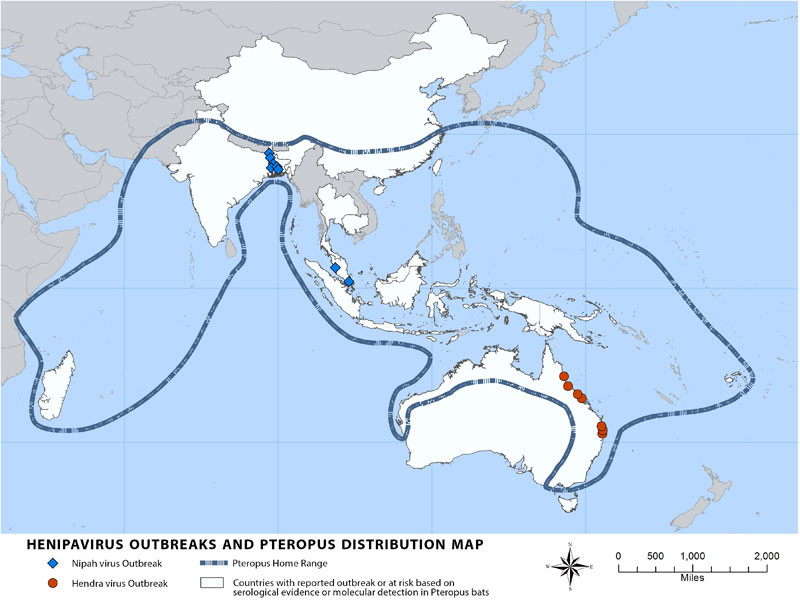
Locations of Nipah and Hendra virus outbreaks and fruit bat habitats.
(Image referenced for informational purposes from www.cdc.gov/vhf/nipah/outbreaks/distribution-map.html)
Nipah Virus is an RNA virus that causes encephalitis and respiratory illness. The disease can be transmitted through contact with animal waste and secretions from carrier animals. The Department of Disease Control, Ministry of Public Health, has classified it as a highly dangerous infectious disease, on par with Ebola, Smallpox, Lassa Fever, Hendra, and Marburg viruses. Therefore, physicians must test patients in specialized laboratories.
From the wild to humans, we find that "Fruit Bats" are the natural reservoir for this virus. Transmission to humans usually occurs through:
Symptoms of Nipah virus often start like a common flu, causing many people to be complacent.
Diagnosing Nipah virus requires clinical history and laboratory testing. A Patient Under Investigation (PUI) is someone with respiratory symptoms or encephalitis and a risk history, such as contact with secretions from fruit bats, pigs, or other patients.
Build a shield for yourself and your family by focusing on these simple self-care tips:
The fear of disease decreases when we are knowledgeable and cautious. Ramkhamhaeng Hospital would like to encourage everyone to always maintain good health, as our best wish is to see everyone healthy every day.
Specialist in infectious disease Clinical Microbiologist

Pediatric Pediatric Infectious Disease

INTERNAL MEDICINE, SUBSPECIALTY INFECTIOUS DISEASES

Infectious Disease