Patient Testimonial

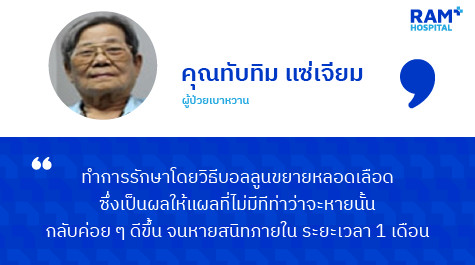
She had been living with diabetes for over 20 years and had previously developed a chronic foot ulcer that failed to heal, eventually requiring the amputation of four toes.
Not long afterward, a small red spot appeared on the sole of his foot, resembling a mosquito bite, which later developed into a wound. Despite regular cleaning and wound care, there were no signs of healing.
Approximately 6–7 months later, the affected toe became swollen and red, and his mother noticed that she was experiencing pain in the toe. She then took him to see a physician at Ramkhamhaeng Hospital.
After evaluation, the physician explained that the condition was caused by peripheral arterial disease. Treatment was performed using balloon angioplasty to dilate the narrowed blood vessels. As a result, the previously non-healing wound gradually improved and completely healed within one month.
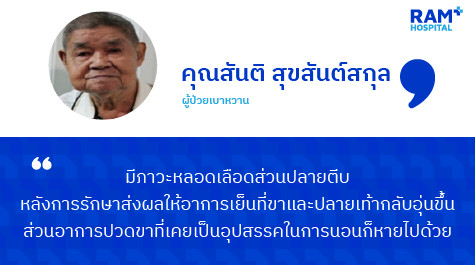
He had been living with diabetes for many years when he suddenly began to experience leg pain. When he touched his leg and toes, he noticed that they felt abnormally cold, as if standing on ice. Even using an electric blanket provided no relief.
These symptoms occurred mostly at night, preventing him from sleeping and forcing him to rely on sleeping medication every night. Eventually, his daughter, who was his primary caregiver, could no longer bear to see him suffer and took him to consult a physician at Ramkhamhaeng Hospital.
After examination, he was diagnosed with peripheral arterial disease. Following treatment, the cold sensation in his legs and toes improved, becoming warm again, and the leg pain that had interfered with his sleep completely resolved.
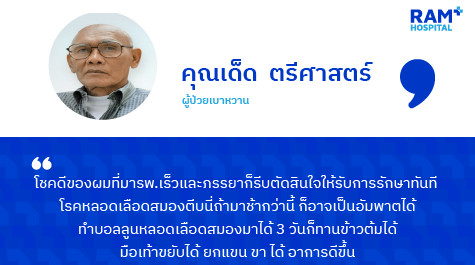
“When I arrived at the hospital, the entire left side of my body—both arm and leg—was weak. After the onset, I felt unable to move. When asked to lift my arm, I felt pain in my shoulder; when trying to lift my leg, I couldn’t and felt pain in my thigh.
The doctor performed a CT scan of the brain and recommended treatment with balloon angioplasty for cerebral artery stenosis. I was fortunate to arrive at the hospital quickly, and my wife made the prompt decision to proceed with treatment immediately.
With cerebral artery stenosis, if treatment is delayed, it can lead to paralysis. After undergoing cerebral balloon angioplasty, within three days I was able to eat rice porridge, move my hands and feet, and lift my arms and legs. My condition improved significantly.”