
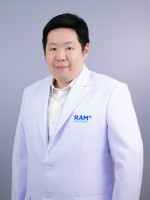
ARUNEE TANGSIRICHAIPONG, M.D.
Ophthalmologist



Age-Related Macular Degeneration (AMD: Age-related Macular Degeneration) is an abnormality that occurs in the retina due to aging, which is most commonly found in the elderly. According to a 2009 survey by the World Health Organization (WHO), age-related macular degeneration remains a leading cause of vision loss, ranking behind cataracts, refractive errors, and glaucoma


Age-related macular degeneration may present differently depending on each patient's condition. It is also difficult for patients to notice visual abnormalities by themselves in the early stages, especially if the other eye still sees well; the patient may not notice any abnormality for years.
If macular degeneration occurs in both eyes, patients will quickly notice visual disturbances, such as blurred central vision, missing parts in the center of the visual field, dark spots, or distorted images.
Mostly found in the elderly, it is believed to be part of the body's natural degenerative process. Several risk factors have been identified that influence the development of age-related macular degeneration, including:
Even if your vision seems normal, you should undergo an eye health examination (including a retinal check-up) every 2–4 years. For individuals aged 50 and older, a yearly or biennial exam is recommended. Because most patients do not notice any early-stage symptoms of age-related macular degeneration, early detection and prompt treatment are essential. If left untreated for a long time, the degenerated retina will continue to deteriorate progressively.
Current medical treatments can only stop or delay the degeneration of the retina as much as possible.
An ophthalmologist specialized in retinal diseases (Retina specialist) utilizes specific methods to detect abnormalities, including:


Retinal examination using an OCT (Optical Coherence Tomography) machine is a diagnostic tool that detects pathology across various layers of the retina, providing high resolution down to approximately 0.01 millimeters. The procedure is quick, simple, entirely painless, requires no injections, and involves zero radiation exposure.


Generally, individuals aged over 50 should receive a comprehensive retinal examination by an ophthalmologist to evaluate their risk of developing the disease.
Ophthalmologist

Ophthalmology

Ophthalmology (Retina and Vitreous)
Retina and Vitreous


