Patient Testimonial

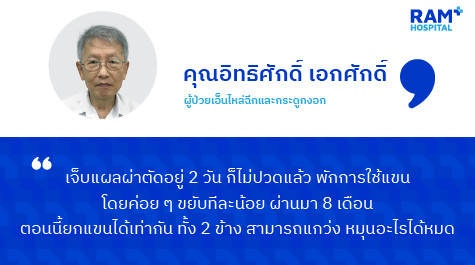
After two days, the pain subsided, but I rested my arm, gradually moving it little by little.
Mr. Ittisak experienced increasing pain when lifting his arm, eventually making it impossible to lift anything due to sudden sharp pain. An MRI scan revealed a clear bone spur shaped like a canine tooth.
The doctor initially suggested an injection to see if it would resolve the issue, with surgery as a last resort. However, it didn't improve, so he sought out Dr. Sirisak, who found both a torn tendon and a bone pressing on it. This required arthroscopic surgery to repair the torn shoulder tendon and shave down the protruding bone. Two days later, the surgery was performed. The surgical pain only lasted two days while in the hospital. After those two days, the pain was gone, but he rested his arm, gradually moving it. Now, eight months later, he's recovering well, able to lift both arms equally and rotate them freely.
Cardiac Rehabilitation for Heart Patients
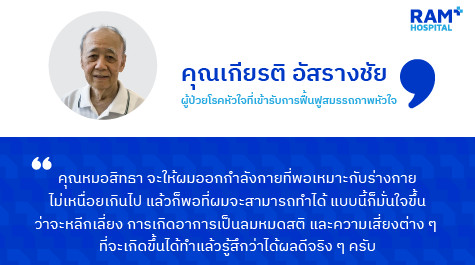
"Engaging in this exercise regimen has significantly boosted my confidence, helping me avoid fainting spells and mitigating various potential risks."
A patient with a 20-year history of high blood pressure, managed with medication, discovered three coronary arteries were 75-80% blocked. They underwent balloon angioplasty for one vessel. Due to the tortuous nature of the other two arteries and the patient's age, a Ramkhamhaeng Hospital consultation led to successful angioplasty on the remaining two.
About half a month later, the patient enrolled in a rehabilitation course at the Cardiac and Pulmonary Rehabilitation Department. This post-treatment step aims to restore normal daily activities, enhance self-care, safely control the condition, and reduce recurrence risk.
"Each session, Dr. Sittha tailors my exercises to be appropriate and manageable, avoiding overexertion. Besides walking, I cycle to strengthen my legs and use a treadmill at a faster pace than at home to improve my stride. Arm exercises involve resistance bands to strengthen arm and shoulder muscles. Each activity lasts 15-20 minutes. I didn't exercise much before, but now I'm confident I can avoid fainting and other risks. My blood pressure is stable, ensuring my heart isn't overworked. I plan to continue for another course after this one, which consists of six 50-minute sessions; it has been truly effective."
Expert Insight on Cardiac Rehabilitation
Assistant Professor Dr. Sittha Pongpibul, a specialist in cardiac and pulmonary rehabilitation, exercise for disease treatment, and sports science at Ramkhamhaeng Hospital, states that rehabilitation typically lasts 2-3 months. Regular assessments ensure patients can safely exercise at appropriate intensity, and that heart and lung function improve, building confidence for normal activity.
"Cardiac and pulmonary rehabilitation exercises must be jointly designed by the treating physician and a specialist. They consider each patient's pathology to determine the appropriate exercise type, equipment, and duration per session. Close monitoring of heart rate, blood pressure, and body response is crucial, as some conditions, like myocardial ischemia or a history of heart failure, can lead to abnormalities during exercise. For instance, heart failure patients might experience a drop in blood pressure due to inadequate pumping, requiring exercise adjustments. The heart rate graph and blood pressure must gradually rise without becoming too high or showing signs of myocardial ischemia. Crucially, equipment must be readily available for immediate patient assistance."
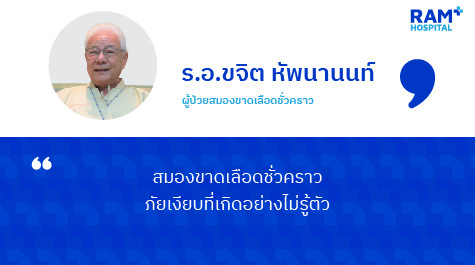
Captain Khachit Hapnanon shares his experiences with transient cerebral ischemia, warning signs of paralysis.
"While I walking, exercising around the evening at my home as usual. After walking only 3-4 hundred meters, I felt tired faster than ever but I thought that it was because of the hot weather, so I took a rest for about 10 minutes but I’m still tired, so I decided to stop walking so as not to force myself...
When it's time for food. I can eat 2-3 times, put a spoon, and sit back and watch TV. But in truth I felt tired After a while, my wife came to talk and asked several questions, which my wife had already wondered, why did not answer correctly As for me, I don't know what to answer, but I feel dizzy as I sleep, but when I close my eyes, I'm tired ...
My wife told me to go to the doctor. While I’m standing up, my fingertips trembled. The left hand is completely numb, the index finger, middle finger and ring finger become numb, so I massage myself. But soon the arms were numbed to the shoulders. So I started to notice that this is a classic case of paresis. I had a history of large blood vessels, brain blockage at the neck last year. It’s Make me wonder to be the same again. Which may have a fat cube or something to fill ... but while waiting for the car to pick up for about 2 minutes, the numbness disappears. As soon as it disappeared, I’m not falling asleep anymore, my eyes lit up immediately… "
Dr. Ariya Thima, MD. Brain and nervous system specialist of Ramkhamhaeng Hospital
After the patient visits as well as "Electromagnetic waves" or MRI Scan and I know that ... The veins previously detected have narrowed 50% ... is a "transient ischemic attack" or TIA, so many symptoms appear, but they disappear in just 5-10 minutes. Regarded as a warning sign of paralysis by narrowing of blood vessels in the left hemisphere Which is the communication control center. Causing the patient to speak or answer questions that are not relevant. Also, the patient had a history of diphtheria arteriosclerosis. If it is slightly narrowed, either in the brain or the neck. Treatment with antiplatelet drugs, along with saline and blood pressure-lowering drugs In which case, fortunately, the fat flakes are not very large, so they melt on their own. By causing a temporary ischemic brain and self-healing What is joyful is that I was not alone at the time of the symptoms.
Statistically, about 10% of patients will have a recurrence in the first 72 hours, so I have to tell myself that TIA is a warning sign of paralysis. Therefore, if it occurs after 5-10 minutes, then it is advisable to go to the hospital as soon as possible.