
Patient Testimonial

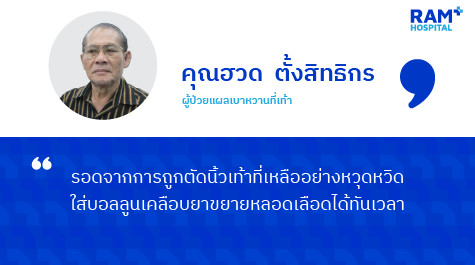
"Mr. Huat Tang Sittikorn, who is 71 years old, told me that he had diabetes for 37 years. While the foot wound just happened a few years ago, with his daughter Ms. Siriporn helping to burden him. Taking care of the wound itself, brought him to the clinic and hospital. At first, the wound was only on the thumb but it treats for a year and still hasn't healed. And there are still more wounds until 4 toes have been amputated and the wound is beginning to spread to the fifth finger."
His relatives were seen on TV shows that at Ramkhamhaeng Hospital, there is a technique to widen blood vessels to help heal diabetic wounds. Therefore hurriedly brought him to contact for treatment immediately.
After Dr. Suthat accepted him for a thorough examination. Explained that it is caused by veins in the legs, which means the end of the blood vessel is blocked causing the blood to not flow to the toe. Therefore causing the wound that occurs that cannot be healed And the nerves in that area will not be perceived. He does not feel pain in the wound. And brought him to the color injection to see the condition of the peripheral vascular. It was found that the stenosis area was below the knee, and his veins or blood vessels had already become completely blocked by 2 of the 3 and the remaining ones were clogged at intervals. Includes 2 positions, each of which is 8 cm and 12 cm long.
Our doctors inserting the balloon into the blood vessels up to the constricted position and pumping air into it, inflating the balloon all around, resulting in immediate inflation of the blocked blood vessel, allowing blood to reach the toe. In time to survive the amputation of the remaining toe.

Former Patient with Trigeminal Nerve (Cranial Nerve V) Inflammation
I have had symptoms of facial nerve inflammation in the fifth pair for about 5 years, but in the last three months, the symptoms started to get worse. From the long lower lip to the lower ear area. Very sore. At first, it feels like teething, sore teeth. At first, I thought that it might be a dream of decay. Or having teeth-related symptoms but not
The disease is related to everyday life such as eating, talking, or just opening your mouth, drinking coffee, drinking water, or taking a shower, stroking your hand on your face, and it hurts sorer and sorer than giving birth. This disease so decided to undergo surgery because 3 months of weight lost 10 kg.
I want to tell people who think they may have fifth neuropathy if they touch their face or that the wind blows. Or if you rubbed your hand on the cheek and hurt You don't have to wait for it to chew or can't open your mouth. Or waiting for the tooth to be extracted To hurry to see a doctor.
And then had asthma, a congenital disease. Which has to spray a bronchodilator every day. Used to consult a doctor at another hospital. Cannot perform surgery Until seeing Dr. Methi At Ramkhamhaeng Hospital, And he said that it could be dissected without any side effects. And not dangerous so decided to have surgery at Ramkhamhaeng Hospital.
Asst. Prof. Methee Wongsirisuwan Neurosurgeon Doctor
Pain in the face like being electrocuted. Treatment by separating the blood vessels that reach the fifth nerve by surgery. Nowadays, advances in medical technology have enabled laparoscopic surgery. Allows the size of the wound behind the ear to be 2 inches without any need to shave. Just separate some of the hair around the back of the ear to keep the wound clean. The surgery takes about an hour. To separate the blood vessels that reach the nerves apart. Then block the medical material so that it doesn't come back to touch the nerve again. After a few days, Most patients can go home.
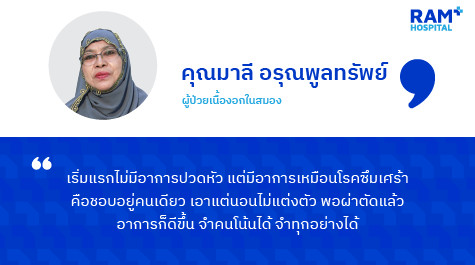
Former Brain Tumor Patient
"I had no headaches, but displayed severe depression-like symptoms; I preferred to be alone, only slept, and neglected my appearance."
Starting around September 2019, I would just sleep, refusing to speak or interact with anyone, and stopped teaching. I also experienced dizziness and neglected work. My mother suggested I get checked at Ramkhamhaeng Hospital. We called to consult with a nurse, describing symptoms that, from our research, resembled depression. We brought him to a psychiatrist, even though he had no headaches. For about a month, starting in December, he came weekly but didn't improve. He started losing bladder and bowel control, suggesting a brain issue, as the brain controls everything. So, that day, he had to undergo an MRI, waiting four hours to ensure he was ready. The doctor informed us it was extensive, with tumors all around.
The doctor told us to prepare for a 10-hour surgery. We agreed, and the surgery began. Afterward, he was disoriented and agitated, trying to pull at his stitches and tubes, so we had to constantly monitor him. Gradually, he improved, recognizing people and remembering everything. Each time he saw the doctor, they would check his brain function by having him do simple math. He continued to improve, able to recall and do calculations. The doctor explained that after the surgery, the brain tissue where the tumor was removed needed time to recover from the compression it had endured.