Patient Testimonial

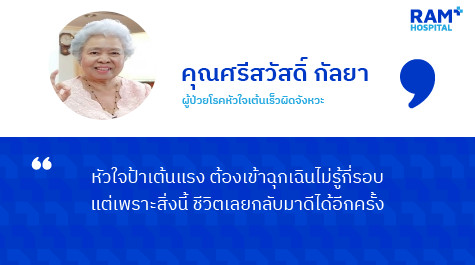
Former Arrhythmia Patient: Srisawat Kalaya's Story
Srisawat Kalaya visited the doctor experiencing "cardiac arrhythmia," or an abnormally fast heartbeat. He described the initial phase of his condition, which involved chest pain and easy fatigue. He sought medical attention, received medication, and felt better for a while. However, his symptoms would return intermittently, eventually becoming more frequent and prolonged, significantly impacting his daily life. There were times his heart would pound continuously from 8 AM to 2 PM. This led him to revisit his previous hospital, where doctors recommended radiofrequency ablation to treat the heart muscle.
Choosing Ramkhamhaeng Hospital for Treatment
When serious treatment became necessary, Srisawat and his family decided to transfer to Ramkhamhaeng Hospital. They were confident in the medical team's expertise and the hospital's advanced equipment. After a thorough re-diagnosis, the doctor recommended a treatment plan, and Srisawat chose to undergo catheter ablation to target the abnormal electrical impulses in his heart.
Swift Recovery and Normal Heart Rhythm
Srisawat's recovery was remarkably quick; he stayed at the hospital for only one night and was discharged the following morning. A week later, he had a follow-up appointment, and tests confirmed his heartbeat had returned to normal.
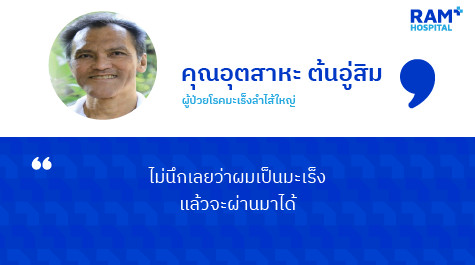
Mr. Utsaha Ton-Ousim, a colon cancer patient who has trusted Ramkhamhaeng Hospital for over 20 years, shared his journey with the disease.
Initially, he experienced warning signs like narrower stools, irregular bowel movements, and mucus with blood, which he dismissed as hemorrhoid symptoms. He only sought medical attention when he started passing pure blood. Prior to this, he also had kidney stones with recurring pain in that area.
Upon examination, doctors diagnosed colon cancer through questioning and endoscopy, pinpointing the tumor at the site matching his previous symptoms. They surgically removed the mass and some lymph nodes to check for metastasis. Fortunately, lab results showed it was Stage 2 colon cancer, requiring only surgery and oral medication for treatment.
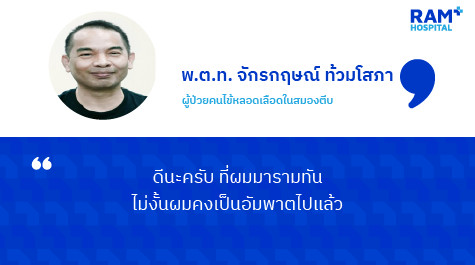
Former Stroke Patient's Account
"While traveling, I experienced constant dizziness that progressively worsened. Upon arrival at the hospital, I first saw an ENT specialist who checked for fluid balance in my ears; the results were normal. Fortunately, the doctor suspected something more and referred me to a neurologist. The neurologist determined my blood pressure was elevated, and I had a slight facial droop, leading to an immediate MRI. The scan revealed a cerebrovascular issue requiring urgent treatment. The doctor explained the treatment, and once I agreed, they administered a clot-dissolving drug immediately. Within six hours, my dizziness subsided. I'm incredibly fortunate that I arrived in time and that the doctors provided such attentive care; otherwise, I would have been paralyzed."
Early Detection is Key
Police Lieutenant Colonel Jakkrit's case is exceptionally fortunate because he recognized his symptoms and sought prompt medical attention. If the brain is deprived of blood for more than three hours, the chances of a full recovery significantly decrease. Therefore, everyone must monitor their symptoms and those of their loved ones.
Do not ignore symptoms such as sudden weakness or numbness on one side of the body, slurred speech, loss of balance, decreased vision, or even temporary dizziness, tingling in the hands, or weakness that resolves on its own. These could be signs of a transient ischemic attack (TIA), which often precedes a full-blown stroke. If you experience any of these symptoms, seek immediate medical attention.