Patient Testimonial

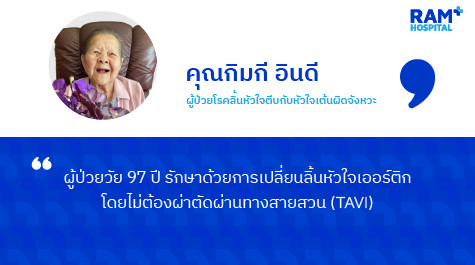
Aortic Valve Stenosis with Cardiac Arrhythmia
“A 97-year-old patient treated with Transcatheter Aortic Valve Implantation (TAVI), without open-heart surgery.”
“…During the period when COVID-19 began to spread more severely, ‘Khun Yai Kimki’ told her children and grandchildren to postpone doctor visits for the time being. However, after being away from medical care for about 7–8 months, she began to experience fainting episodes 3–4 times a week.
Her children and grandchildren, who were caring for her, took her to a nearby hospital as they felt it was an emergency and should not be delayed. Out of trust in Ramkhamhaeng Hospital, they contacted the hospital to seek treatment with Dr. Vichai Srimanus.
Upon arrival, she underwent a step-by-step diagnostic process, leading urgently to cardiac catheterization with contrast injection. This allowed the cause to be identified and continuous treatment to begin. It was determined that the underlying problems were aortic valve stenosis and cardiac arrhythmia.
Her daughter, Khun Phosri Indi
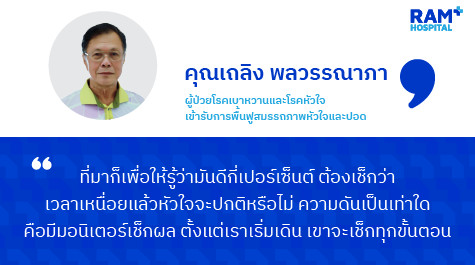
Diabetes and Heart Disease Patient Undergoes Cardiac and Pulmonary Rehabilitation
"The reason for coming is to know what percentage of improvement there is, to check if the heart is normal when tired... what the blood pressure is. There's a monitor checking results from when we start walking; they check every step."
An elderly patient with diabetes and a history of treatment at Ramkhamhaeng Hospital, who had complications requiring coronary angioplasty, enrolled in the Cardiac and Pulmonary Rehabilitation Center at Ramkhamhaeng Hospital. He explained his reason for attending: "...I came here because of my history, and also because all the doctors are excellent. They offer specialized packages for elderly patients that require continuous follow-up check-ups... As for the rehabilitation, it's to know the percentage of improvement, to check if my heart is normal when I'm tired, and what my blood pressure is. They monitor every step. They check results from the moment we start walking, like how sugar levels are before exercise, how much sugar drops, and how much it decreases if I'm very tired... For heart issues, the primary need is for knowledgeable doctors and proper equipment. So, I advise with concern that if you're ready to take care of your body, go to a hospital with a good system."
Associate Professor Dr. Sittha Pongpibul, a specialist in cardiac, pulmonary, and exercise rehabilitation, explained the primary reasons for Mr. Thaloeng's case: to modify risk factors for re-stenosis, such as diabetes, hypertension, high cholesterol, sedentary lifestyle, and obesity. Mr. Thaloeng, being diabetic with poorly controlled blood sugar, has a higher risk of new blockages compared to those without these risk factors. Therefore, he underwent the rehabilitation exercise program, which helped lower his blood sugar, making it another way to improve blood sugar control for diabetes. Additionally, it helps the heart function better, become stronger, and more efficient. Long-term adherence will reduce the risk of re-stenosis.
Recommendations include:
"...Generally, first, for diabetic patients with high sugar levels and a glucose meter, we advise frequent sugar checks to know how much the sugar swings throughout the day—morning, noon, afternoon, evening—to correctly manage diet. Second, once sugar levels are clearly monitored, they'll know how much they should exercise. For example, if it's high in the morning but low in the evening and they prefer evening walks, they'll know how much to walk. Other advice, such as controlling risk factors for re-stenosis and proper nutrition, can be discussed in detail with a dietitian. Roughly, it doesn't mean you can't eat anything... You can still eat everything, but in limited quantities. Some people misunderstand that they can't eat sweets at all, which isn't true, as even eating rice can raise blood sugar. Mr. Thaloeng looks better; he seems more confident. Initially, he was worried about high sugar, but after we showed him how exercise lowers it, he gained confidence and can exercise more without abnormal symptoms."
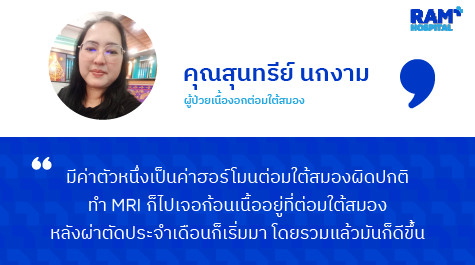
"About 3 months after surgery, my period returned. Overall, things improved."
Initially, I saw a gynecologist for abdominal pain and missed periods. My internal exam was normal, so they sent me for a blood test. The results showed an abnormal pituitary hormone level, so I was referred to the endocrinology department. An MRI then revealed a mass on my pituitary gland.
I was scheduled for surgery, but they found a fungal infection in my sinus cavity, so I had to have sinus surgery first. A relative then recommended Ramkhamhaeng Hospital for brain surgery, mentioning good doctors and reasonable prices. So, I researched Ramkhamhaeng Hospital for pituitary tumor surgery. I decided to take my X-ray films to Dr. Nophasin, who performed the surgery with Dr. Puripun.